|
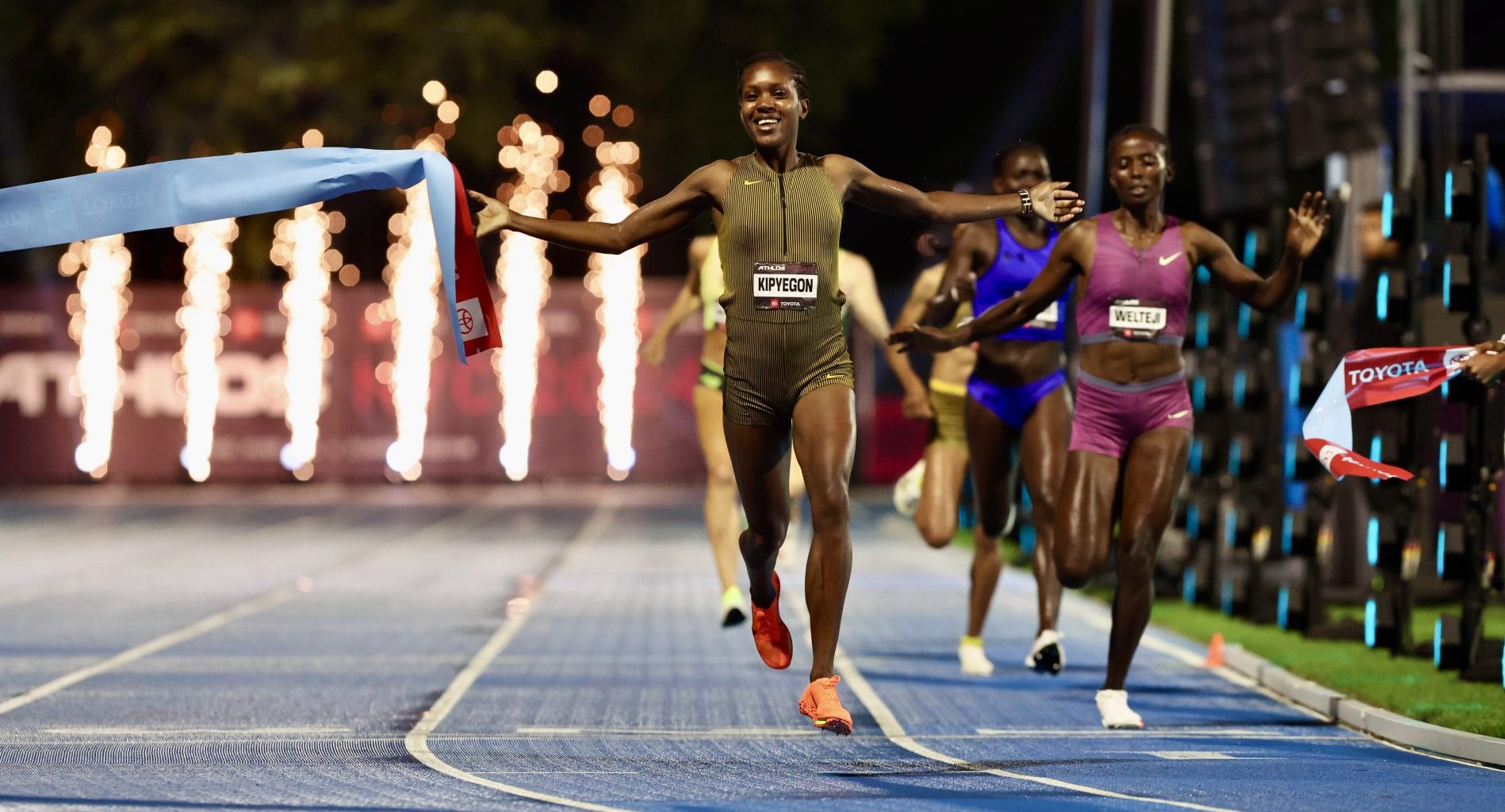
Nike has announced its latest science experiment/marketing stunt: Breaking4, a sub-four-minute mile attempt by Kenya’s Faith Kipyegon this summer in Paris. The big swing—Kipyegon currently holds the world record at 4:07.67—has drawn skepticism. The operator of one popular running website called it “la-la land.”
Nike’s new CEO, Elliott Hill, has emphasized getting the company back to its roots in sports and high performance. He promised Kipyegon’s “moonshot” would feature “cutting-edge sport science with revolutionary footwear and apparel innovation.” The company has been cagey about what specific accommodations it might make for Kipyegon’s attempt.
But it’s run similar events before. The company organized two attempts for Eliud Kipchoge to break two hours in the marathon: Breaking2. The first missed but came far closer than anyone expected, and the second one, in 2019, succeeded. (It did not count as a world record because it violated several rules around pacing and fluids.)
Will Breaking4 be as successful as Breaking2? FOS asked five experts about the spectacle. Their answers have been edited for length and clarity.
- Wouter Hoogkamer is a professor of kinesiology at the University of Massachusetts, Amherst and co-author of a study that suggested that Kipyegon could break 4:00 with better drafting.
- Shalaya Kipp is a postdoctoral research fellow at the Mayo Clinic and co-author of the drafting study. She competed at the 2012 Olympics in the 3,000-meter steeplechase.
- Steve Magness is an author of several books on the science of running, and the former cross-country coach at the University of Houston.
- Alex Hutchinson writes the Sweat Science column for Outside magazine, is the author of several science books, and was a former elite athlete.
- Ross Tucker is a researcher and host of The Real Science of Sport Podcast.
Broadly, is this possible?
Hoogkamer: Yes. We have published on the benefits of aerodynamic drafting before, and even though that will only provide enough time savings in the most optimal scenario, I think that with additional improvements [in Kipyegon’s fitness] and from improved shoes, it’s possible.
Kipp: Yes, and we’d say drafting [a technique to reduce drag] will take an important role.
Magness: It’s possible, not likely. Six or seven seconds is a large jump, especially since many of the interventions that helped close the gap for the marathon (i.e. super shoes) have already been taken advantage of by Kipyegon. She’s presumably already used bicarb [a popular supplement] as well. We’d need to see something innovative and new to drop that much time.
Hutchinson: Under “business as usual” conditions, it’s not possible. But I guess the entire premise of this project is that it’s not business as usual. Whether it’s possible or not depends on what tricks they’ve got up their sleeves.
Tucker: Of course. It just depends how much one is prepared to “bend” what is acceptable … If you move enough of the constraints and barriers out of the way, then you can do anything. To provide a ridiculous example, if you run it down a straight road with a downhill gradient of 5% the whole way, then you can do it with 20 women. But unless they take some radical steps, I think eight seconds is too much to find within any reasonable understanding of what running a track mile currently looks like.
What’s the fastest Kipyegon can run in 2025? How much faster will women’s milers get in our lifetimes?
Hoogkamer: 3:59.5 seems feasible. I think that in 20 years someone will be able to run sub-4:00 with record-eligible drafting strategies, meaning female pacers only, all starting at the same time. Mainly from improved training, nutrition, and shoes.
Tucker: Without any additional gimmicks added, I think 4:07. I think Kipyegon is on the flat part of her own performance curve, where she is looking for a one-second improvement.
Magness: In a race with some modifications, I think Kipyegon can get down to 4:03 or so. Women will get under 4:00 in our lifetime.
Hutchinson: Whenever someone runs a really fast time—like Kipyegon did last year—my assumption is always that they’ll never run faster again. I’d expect women to run maybe 4:03 or 4:04 sometime in the next couple of decades… unless there’s an unexpected innovation, which is always a possibility.
Do you find this interesting? If you had unlimited Nike dollars to run some big running experiment, what would you do?
Tucker: I find it extremely off-putting, actually. I’d rather this sort of thing never happened. I think it’s gimmicky, and invites some sketchy practice … Overall, I find these attempts, and all the marketing that goes along with them, pretty annoying … I remember how “the best available sports science” was going to be provided to those sub-2:00 athletes; I reckon the shoes did 95% of the job.
Hutchinson: I have mixed feelings about it, just as I did with Breaking2. But on balance, yes, I find it interesting. I’ll certainly tune in to watch the race. These sorts of exhibition races aren’t without precedent. Roger Bannister famously ran a race with lapped pacers whose result was disallowed because of illegal pacing, as a stepping-stone toward his eventual sub-four.
Magness: I think it’s interesting. I wish we just had a natural progression. … I think we do lose a little when it’s manufactured. But I’m not a pure purist, so I think it’s still an interesting endeavor. And sadly on all of these things, that actual biggest bang for your buck would be doping. If you wanted to throw everything at it, that’s how you’d get there, especially on the women’s side, where doping can have a larger relative effect. So you’d love to see some anti-doping testing tied in with it. But who knows.
More to the story: FOS’s Dennis Young spoke in depth with the experts about the sports science of the experiment—including how Kipyegon could specifically break 4:00.
|