
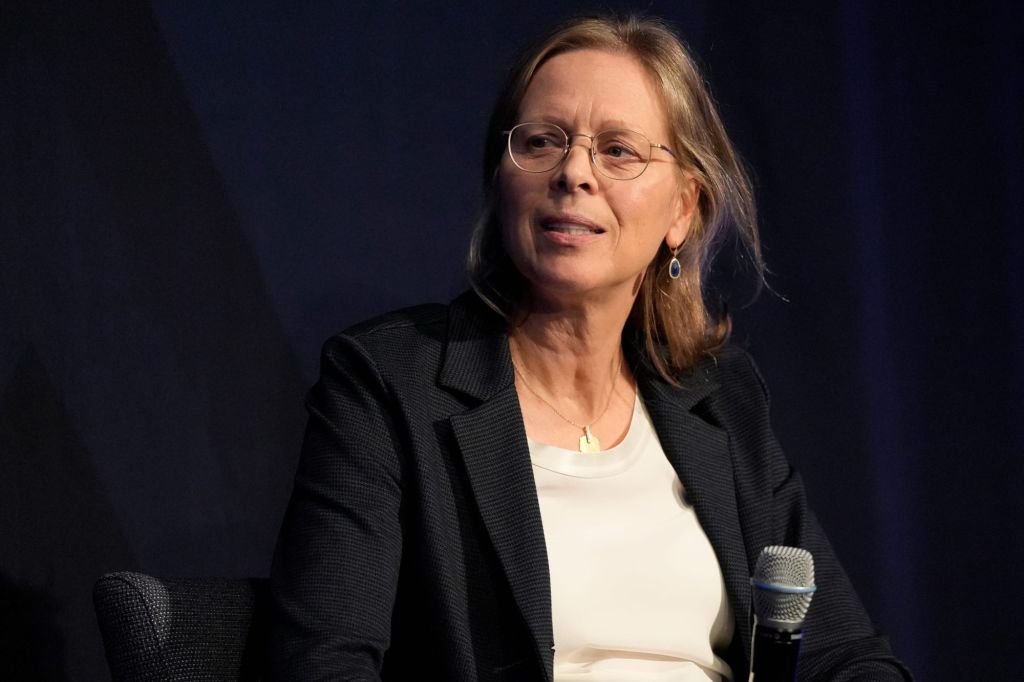
Every Saturday, Front Office Sports will bring you one of the week’s best conversations from our daily podcast, FOS Today. To kick it off, we’re highlighting host Owen Poindexter’s interview with Val Ackerman, commissioner of the Big East and founding president of the WNBA. We spoke with Ackerman about what the unionization of Dartmouth’s basketball team means for the NCAA’s future and about her own experiences as a college athlete—and she explains why not all conferences are created equally. To hear the whole conversation, check out the episode here. The following has been edited for clarity and length.
Front Office Sports: Let’s start with the big news in college sports: Dartmouth basketball players voted to unionize. Dartmouth is not a Big East school, but this is likely to have repercussions across the NCAA. What are your thoughts on the vote?
Val Ackerman: Not a surprise, given the ruling that the regional director came up with in February that declared that they were employees entitled to do just that, to create a union. So the stage was already set. This was really the second step in that process. We’ll see what happens next.
My understanding is that there will be appeals on this decision. It’s just too early, I think, to know exactly how this will play out, what the impact will be there, how that would affect potentially other schools, and what it means ultimately for the collegiate model.
FOS: There are still a lot of dominoes to fall here. This could be tied up in the court system for a good little while—but we could well be heading toward a post-amateurism world, essentially, where college athletes are employees or are at least able to get paid and could well be collectively bargaining. Is the Big East ready for that? And is the NCAA ready for that?
VA: I guess the short answer is: Nobody’s ready for that. I would just point out here in terms of clarity, there is a quid pro quo already for the athletes who are attending schools and playing for these programs. I was in that camp. I got a full scholarship to play basketball in college, had a host of other benefits, because of my participation on my team: I graduated debt-free, got into a school I probably wouldn’t have gotten into but for my athletic talents.
And so I guess I take issue with the notion that they’re not getting anything for the experience. So I think that the precise way to describe it is: There is a push now to go further than that and to declare them employees who would be subject to a minimum wage, overtime, workers comp, in a taxable relationship. The benefits that athletes get right now are not taxable. So the notion that the relationship could be transformed into a taxable relationship would be very dramatic, could have unintended consequences. So I think I would sort of amend your question to say: Are the schools and the NCAA ready for that? And add: Are the athletes ready for that?
FOS: That’s an interesting way to put it. We don’t really even know what it’s going to look like. But I imagine there has to be some level of preparation for a new world here, because it feels like—whether it’s the Dartmouth case or any of the other legal challenges to the amateurism model—this is happening one way or another.
VA: Well, yeah, to the extent that it’s in the courts, it is happening. And to add some clarity to my perspective on it, it may well be that certain athletes in certain sports, particularly athletes playing high-level football at certain schools, may need to have their relationship with their universities adjusted because of the benefits they’re providing to their universities.
Division I is sort of a band, and those athletes are at the top level of the band. What I would submit is that on the lower level of the band, the benefits are probably going more the other way: Playing on a team is providing more benefits to the athletes than it’s providing to the university by virtue of their participation.
I think the thing that does have to get sorted out here, and it’s not simple, is where the intersection of the federal labor laws, antitrust laws, and Title IX are colliding. How those three federal laws can be reconciled in a way that sustains these programs, creates, as you noted, potentially a new relationship between these athletes and their schools, and make sure that the kinds of benefits that athletes have been getting for years, particularly in non-revenue sports, can continue. It may well be that something has to give in the system to make sure that certain sports are given a different status. And that, I think, is the big unknown: What could this mean, not just for that band of sport, but for Division I?
FOS: I’m curious about how this shakes out among different sports. A lot of the major changes in college sports have been driven by football. The Big East is a major non-football conference. So I’m wondering if you feel swept along with these changes that are … largely coming from football.
VA: I think you’re right. I think that conferences that are not in the same boat as the high resource football leagues, on one hand are out of the fray. The realignment moves that I’m sure your listeners have heard about are football driven, and they have created some very challenging geographic configurations. You’re going to have athletes crisscrossing the country to play games in ways that are going to create, at least right now, unforeseen consequences.
We can only guess what the effects of that travel and time out of the classroom, time away from campus and socializations with non-athletic students are going to look like. We don’t know. That’ll hit in July.
So, we’re not going to be affected, I think, for the near term in the same way that the football leagues are. But as you noted, the kinds of challenges to the collegiate model ultimately will affect probably everybody.
Given how state laws work, the different situations that various schools are in, whether some of these developments would be optional, whether they would be mandatory under the law, what they would cost in real dollars and how that might impact non-revenue generating sports—these are unknowns. And so we’re trying to monitor it. I think every league is doing that. Trying to do a little bit of crystal balling, but the ball’s pretty cloudy right now.
FOS: Yeah, that makes a lot of sense, given that there are multiple court challenges from multiple places; there are state laws in play; there are different conference bylaws in play… . This is all just looking into the clouds and trying to see shapes.
On the conference realignment point, you mentioned that you’ve largely been insulated from that. If you poke around, you can see rumblings of, Will UConn leave the Big East? Will Gonzaga join the Big East? To what degree are you starting to feel some of those same media-driven forces, just maybe a few years behind what was the Power Five?
VA: Not really. Ironically, because you mentioned the Pac-12, it was the Big East that was picked apart 15 or so years ago by the ACC, when a number of Big East schools at that time left for what they thought were greener pastures in football. Once again, football raises its head. So, think Boston College, Miami, Virginia Tech, Louisville, Syracuse, Pitt. They were all Big East schools and left for football reasons. And so that led to the current configuration of the Big East, which is basketball-focused. We have a few schools that play football. We don’t sponsor it. And so our schools frankly have been happily out of this round of realignment.
Still, it’s beneath the surface for some of our presidents. Like, Oh my god, you know, we went through that too and that was awful. I don’t believe our presidents want to bring back football. Number two: We have had inquiries from a number of schools, principally other basketball schools, about joining the Big East. Other than UConn a few years ago, there aren’t any that have checked all the boxes we want to check.
Geography is a factor. So yes, we’ve talked to schools that are in far flung parts of the country and geography has gotten in the way, at least for us in those conversations. So at the moment we’re standing pat at 11 teams. …
I wish I could tell you what the Big East is going to look like in five years or 10 years. I don’t know the answer, but I think what we have right now is effectively holding things together for us. And the schools that we have are happily basketball-focused.
Listen to the entire Val Ackerman episode of Front Office Sports Today