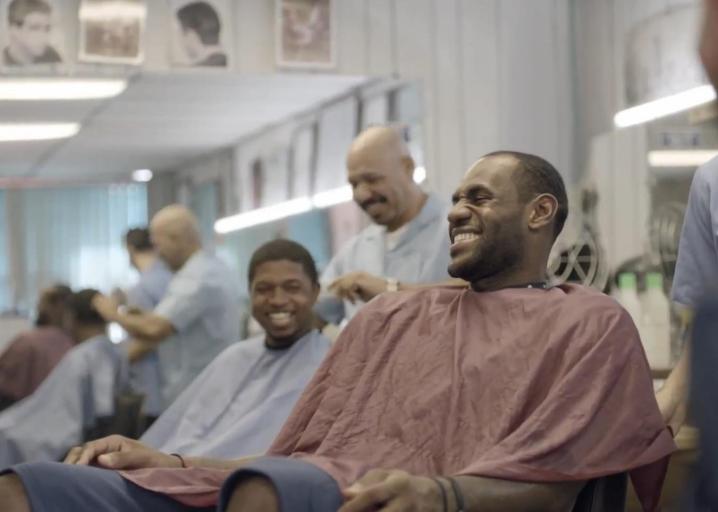
Who knew the situation around a barbershop could be such a hairy situation. (Photo via screenshot of Samsung commercial)
This edition of the Weekly Legal Briefing targets the legislative branch (both Congress and state legislatures) and their role in the governance of the sports industry.
Personally, my interest in sports law began with the Mitchell Report Congressional hearing where Congress conducted an investigation into steroid use in professional baseball. At the time, I was 16 and in high school– playing sick that day was one of the best decisions I have ever made (sorry Mom!). However, watching the hearing was difficult for me: it was hard to watch some of baseball’s most notorious steroid users deny their usage under oath; I had to come to terms with the fact that not all that takes place on a sports field is what it seems to be on tv. Behind the mammoth home runs and hulk-like power hitters of the early 2000’s was a cadre of insecure men who broke the rules and made millions while doing so. At that moment, I felt committed to working in sports in a way that levels the playing field for players who did train and go about their jobs in a legitimate way.
Congressional intervention, either through Congress’ investigatory powers or through it’s power to legislate, has occurred in sports since the professionalization of athletics at the turn of the 19th century. From helmet use in football to questioning the legitimacy of the NFL’s research into CTE, Congressional oversight has unfortunately been necessary throughout the history of sports. As such, it is important for sports professionals to keep an eye on the legislature for new investigations or the passage of new laws that could affect the sports industry: even if they do not explicitly discuss sports.
For example, Congress is currently grappling with the issue of legalizing Marijuana– legislation that facially has nothing to do with the sports industry.
Regardless of personal opinions are of the topic, this is just one example of a policy change that could impact sports in a meaningful way. Most professional sports leagues outlaw the use of marijuana by their athletes through their drug intervention or abuse programs, often as agreed upon in each of their Collective Bargaining Agreements. However, there is still a high frequency of professional athletes who do use marijuana as a non-addictive means of pain management: which leads to a number of athletes being suspended for drug use.
If Congress were to legalize marijuana recreationally, sports leagues would face tremendous pressure from players’ unions to remove cannabis from the list of drugs that are tested for by each league. Thus, unions would press the league during CBA negotiations to drop cannabis from the list of banned drugs due to its new legality.New changes could affect the way player agents advocate for players, the way that teams treat players medically for their injuries likely less reliance on painkillers), the industries that interact with sports from an advertising and marketing perspective (expect the rise of Cannabis company ads), and possibly even the goods that are sold at sporting venues.
Additionally, both the U.S. Congress and the state legislatures have taken direct action with respect to sports. Examples include the U.S. Congress’ passage of the Curt Flood Act (see the previous Weekly Legal Briefing!) and the California state legislature’s recent consideration of a minimum age to play tackle football.
Whether Congress and state legislatures affect sports is beyond the control of the sports professional; however, it is always important to stay on top of both legislative bodies in the event that they change the course of the sports profession by passing a new law or by investigating problems that plague the industry.
To read more about Congressional Oversight in the context of steroids in baseball, check this out.
Here are this week’s sports law headlines:
INTELLECTUAL PROPERTY
Just weeks after a cease-and-desist letter was sent by LeBron James’ production company (Uninterrupted) to the University of Alabama in defense of Uninterrupted’s web series, James has been sued by the owners of a Detroit barbershop who claim Uninterrupted stole the idea from them. The parties are all arguing over a video segment where athletes are interviewed while they get a haircut; this mess illuminates how important it is to be sure that the media production you create for your client does not infringe on protected media of another person. Trademark lawsuits are undoubtedly something that sports professionals, specifically in marketing, media production, and advertising, need to be aware of.
DISCRIMINATION
The NFL was sued this week for age discrimination, the lawsuit is alleging that the NFL has systematically fired security personnel over the age of 60. (This is the second lawsuit related to the the NFL’s security personnel filed in the last month or so– as Eagles defensive end Michael Bennett, unrelatedly, was charged with “injury to the elderly” as he allegedly rushed the field during the Super Bowl in February.) It is absolutely vital that sports businesses remain cognizant of every form of discrimination– there is no place for discrimination or intolerance in sports.
CRIMINAL JUSTICE
As the allegations against disgraced sports Dr. Larry Nassar mount, Michigan State continues to take the decisively wrong actions to attempt to mitigate the damage that Nassar did. In an email to MSU board members, an adviser wrote that board members should not comment on “fake news” coming from Nassar survivors because survivors’ attorneys are “willing to make bold and false assertions” to drive up potential settlement costs.
CONTRACTS
OrangeTheory is alleged to have violated Illinois’ consumer protection laws after members claim that OrangeTheory’s contracts contained misrepresentations about their cancellation policies. According to Law360, “Illinois state law requires gyms to pay refunds to customers who cancel within three days” although OrangeTheory did not make it’s customers aware of that law. The lesson here: if you attempt to manipulate consumers, eventually, you will get caught; and this is problematic because if you have more than one consumer who has been taken advantage of, you could be looking at a consumer protection class action case.