Matt Jones, Myron Medcalf Leaders to Replace Clinton Yates on ESPN Radio
On May 25, the Pac-12 Network staged its final live broadcast from Scottsdale for the Stanford-Arizona baseball conference semifinal. Afterward, announcer Roxy Bernstein delivered the station’s official goodbye message, concluding 12 years in service.
“I was one of the first hires, and have been with the network since the launch,” he said from a broadcast booth with the Pac-12 Network logo behind him. The network played a highlight reel of iconic moments over the last decade, from former UCLA gymnast Katelyn Ohashi’s famous floor routines and a wink from former Oregon phenom Sabrina Ionescu to clips of Washington football, who appeared in the College Football Playoff national championship game.
The network still has a pulse for now, as it shows game reruns for another month. By July, there will be no more Pac-12 Network—but it will transition into a new broadcast studio that may become integral to the conference’s survival.
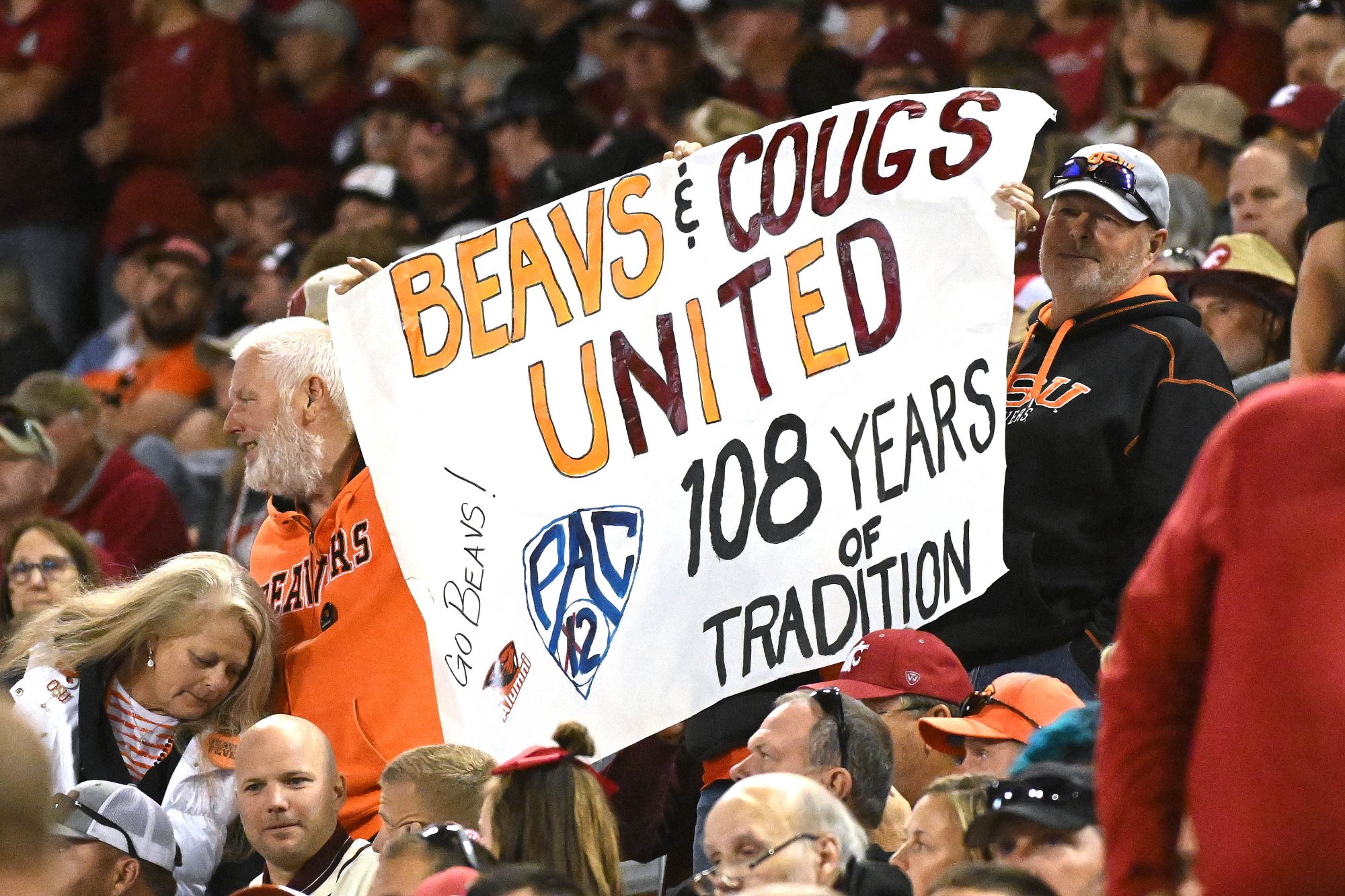
Starting next season, the conference, armed with a multimillion-dollar settlement agreement with departing members, will have just two schools: Oregon State and Washington State. Led by commissioner Teresa Gould, the Pac-12 will continue to do business, just with just a fraction of its former staff. The network will transition into something called Pac-12 Enterprises, producing events for the two remaining schools (and potentially nonconference and pro sports clients) out of its San Ramon, Calif., production studio.
At the end of last summer, it looked as if the Pac-12 was on its deathbed. But “a different version of the Pac-12 will continue into a new era,” Bernstein promised.
In 2011, former Pac-12 commissioner Larry Scott secured a 12-year, $3 billion deal with Fox and ESPN, and he launched one of the first conference-specific networks, partially to highlight Olympic sports. At the time, the package was celebrated as the richest and most innovative in college sports.
But the league presidents opted against giving the Pac-12 Network a broadcast partner. (For example, the SEC and ACC Network are distributed by ESPN, while the Big Ten Network is distributed by Fox.) As a result, the network had distribution issues and therefore became less lucrative. The league then began to fall behind its Power 5 peers in revenue, with the Pac-12 Network dragging it down.
George Kliavkoff, hired to succeed Scott in 2021, was tasked with inking a new deal that would bring the conference back up to standard. He was dealt a difficult hand, made worse by the summer ’22 announcement that UCLA and USC would depart for the Big Ten. But he fumbled media-rights negotiations over a yearlong period. The best he came up with was an Apple TV deal that schools refused to sign. Between July and August, almost every school announced its intention to leave.
By the end of the summer, Washington State and Oregon State were the only two schools left in the conference—but they had no intention of sinking into the abyss.
The day the Pac-12 dissolved, conference network producer Michael Molinari was on a wine-tasting tour in South Africa, watching the news of schools voting to leave the conference roll in on X. “I was hoping till the last second that it was gonna work out,” he says. “Obviously, we know that didn’t happen.”
When Molinari came back from his summer vacation, he rallied his employees. They still had an entire football season left to produce on Pac-12 Network, but he assured every member of the 15–20 person “core” group that he would understand if they took job opportunities elsewhere. They stayed until the network’s football swan-song, a matchup between Notre Dame and Stanford.
Meanwhile, WSU and OSU were concocting a plan for the conference’s future.
In September, they filed a lawsuit against the Pac-12 and Kliavkoff to determine who had the rights to the conference’s assets and intellectual property; the schools didn’t want departing members to dissolve the conference and take its spoils for themselves.
In October, WSU and OSU asked Molinari to advise them on what a two-member conference should do with the San Ramon production facility, which had just opened in August. The complex boasts nine control rooms and some of the most advanced sports production technology. “It’s a one-of-a-kind facility, and very rare on the West Coast,” Gould says. “I think we’re the only conference that owns something like this.”
It obviously didn’t make much sense to keep an entire network for a two-member conference—especially one saddled with legal issues and undesirable from a distribution standpoint. But the network had quality employees, as well as the San Ramon studio. Molinari suggested it could either be sold or kept and used as a bargaining chip in conference realignment. Potential new members could be wooed by the facility’s unique capabilities, as could a conference agreeing to take WSU and OSU in.
Meanwhile, in December, WSU and OSU reached a settlement with departing schools: an agreement that gave them control over the conference’s future, as well as a cushion of more than $100 million from exit fees and other assets. They got the right to keep the name “Pac-12,” which they will continue to use despite being nicknamed the “Pac-2.”
They had the money. Now they needed to find opponents: Rather than trying to negotiate long-term conference realignment agreements, they signed scheduling partnerships with the Mountain West for football and affiliate memberships with the West Coast Conference for other sports.
Leadership change was also in order. WSU and OSU replaced Kliavkoff with Gould, who had worked in the conference office since 2018 and helped oversee success in sports like women’s basketball. Gould, who officially began her tenure March 1, was able to do something Kliavkoff couldn’t: sign a media-rights deal. She inked a package for WSU and OSU home football games with The CW and Fox Sports for the 2024–25 season. Gould also negotiated a pathway for the members to continue to participate in the CFP treated as FBS independents, she confirmed to Front Office Sports in March. (Kliavkoff, meanwhile, has changed his X bio from his previous role with the Pac-12 to “fishing…”)
Gould’s priority now is transitioning the conference office into a lean staff that can still fully support two members. “We worked in partnership with OSU and WSU to look at the next two years and say, ‘What sports are continuing under the Pac-12 umbrella? And what services do they need us to provide?’” she says.
Ultimately, the league decided to keep the San Ramon studio as part of a reimagined broadcast organization: Pac-12 Enterprises. The new entity, which technically begins when the Pac-12 Network goes offline at the end of June, won’t exist as a television channel. Instead, it will be a production facility for Pac-12 events appearing on other networks, like the home football games that will air on The CW and Olympic sports events. Led by Molinari, the production facility plans to go beyond just the Pac-12, however, by serving as a for-hire production facility for college and pro leagues nationwide. Some of the departing Pac-12 members have expressed interest, Molinari says.
“With enough outside work, we hit our overhead—and then at that point, any additional outside work is pure profit for those two schools,” Molinari says. “That would be the best-case scenario.” Once a major liability, the Pac-12’s new network arm could turn into the conference’s biggest asset.
Across the new production group and the conference, the staff will be operating in a much smaller capacity. Gould explained the staff has been reduced from around 195 to about 30 full-time employees (including those running the conference’s revamped network arm). The conference’s remaining staff consists almost entirely of previous employees. Much of the Pac-12’s previous structure will remain intact—just scaled down. PR and communications, legal, and compliance, for example, will all continue to function.
The long-term fate of the conference and its reimagined network is anyone’s guess. But the Pac-12 lives on. For now.