Want more from Front Office Sports
in your search results?
The coronavirus pandemic has completely shaken up the business model of many professional sports. Live sports may be back, but COVID-19 has yet to subside, calling into question the future of fans at stadiums.
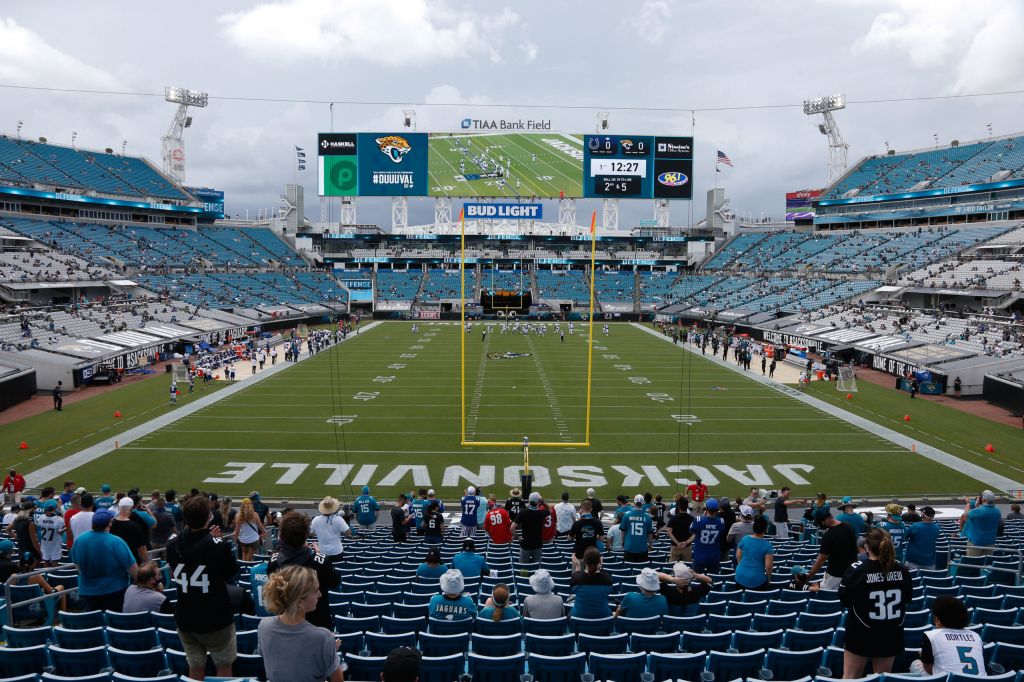
Even with no clear answer as to when — or if — life in the U.S. will return to normal, some sports are taking steps in that direction by welcoming back fans to events. While the Jacksonville Jaguars and Kansas City Chiefs were the only NFL teams that allowed fans to attend their season openers, more than a third of the league now has fans attending games.
With football becoming the first U.S. sport to welcome back fans in the tens of thousands, Front Office Sports posed two questions to various experts in the sports industry: What does the future of stadium capacity look like, and what are the biggest challenges or topics that they will be paying attention to when it comes to the future of stadium development?
The following responses have been lightly edited for clarity.
Logan Gerken, Mortenson vice president and general manager
What are your thoughts on the future of stadium capacity?
We definitely prescribe to the philosophy that the in-venue experience is the ‘holy grail’ of fandom, and without that, everything else doesn’t work as efficiently.
With all the conversations I’ve had, there’s no shortage of people interested in, desiring and yearning to get back in the ballpark, stadium or arena. What we’re seeing in the marketplace is … I would not say a softening of any scale on capacity in venues. If anything, it’s thinking about trying to be smarter and more intelligent about how we handle health and hygiene and cleanliness opportunities within stadiums. We’re thinking about ingress and egress, more touchless fixtures, a cashless payment, and other things.
We’re really accelerating a lot of the technology trends and operational trends that have existed for some time. Some of the leading organizations are implementing them already, but this is going to cause a more rapid adoption of a lot of those operational approaches and technologies within the venue. I wouldn’t foresee a dramatic shift to the business model, such that it would require smaller buildings. I think it’s going to be an acceleration of a lot of the best practices and latest trends that we’ve been seeing.
What are the biggest challenges or topics that you will be paying attention to when it comes to the future of stadium development?
With the retail and hospitality industries feeling so much pain, I think one of the things that we’ve been watching closely is just how do sports anchor developments continue to thrive in the future?
We absolutely would place our bets on the fact that sports anchor developments will outperform their competition in any given market, just given the advantage they have of the association with the team. I think that’s been such a major driver and the real estate investment aspects of that — being able to extend that fan experience and extend the brand — has been such a boost to the industry as a whole.
I’m going to continue to watch and see how that evolves as many main streets around the U.S. are full of empty storefronts. That’s something to watch, but I do believe that sports is a force in itself and it’s going to continue to power through that.
Pete Giorgio, Deloitte U.S. sports leader
What are your thoughts on the future of stadium capacity?
I do think that there will still be something around getting together with a large group of people and cheering on a team. There’s just nothing like sitting in Fenway [Park] with 40,000 of your closest friends and cheering on the Red Sox.
That sort of moment and collective experience — it’s hard to beat. I think there’s still going to be a need for that and a desire for that, and we’ll continue to see stadiums wanting to do that.
There were already a bunch of changes that were happening with stadiums and arenas, and I think those will continue. It’ll be a continuation of a plethora of different options for engaging with the game, whether that be courtside, bars, fantasy areas or other ways to use the facility outside of games. That will continue as well, but I think that will just only continue to — and add to — the need for these types of facilities and arenas moving forward.
What are the biggest challenges or topics that you will be paying attention to when it comes to the future of stadium development?
The biggest thing I’m excited about and paying attention to is how is this period of the last six months going to fundamentally change how we think about sports?
Are we going to see some of these leagues permanently change things like schedules and the timing of their season and their playoff format? The stuff that the NBA’s doing with putting fans on the sidelines — does that stick around?
This crisis has created a sort of round of innovation — some of which won’t be needed anymore once we’re through the crisis, but other parts of which we’re going to embrace and are going to be part of our new normal.
As you think about the development of these [stadiums], it’s actually no longer just the conversation about a stadium or an arena. Typically there is a district around these arenas, right, and there’s practice facilities and districts around those.
This world of using the arena as the focal point and the center point — but also with the shopping and the hotels and all the different parts that go around that too — these are multifaceted businesses going forward. There’ll be not just effects of what happens with the arena, but where does the hotel industry go? Where does the restaurant industry go? What do those look like? How do we need to rethink those two that are a big part of the equation as well?
I think what you will see is this will drive a need for flexibility. The hard, outer shells of these places I don’t think you’ll see change drastically, but the flexibility that they build into them — not just in the arena, but in some of the spaces around them — I think you’ll see a lot more flexibility built into those that allow them to adapt to a world with a six-feet rule or without a six-feet rule.
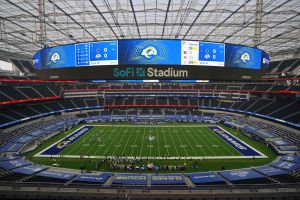
I do think you’ll see a little bit of that coming out of this too, but again, it isn’t just about the arena anymore. These things are multifaceted. What SoFi did [with SoFi Stadium] — it just seems weird to just call something so complex ‘a stadium,’ because it’s actually a stadium, a performance venue, and a whole bunch of different pieces to it.

Andy Loughnane, Austin FC president
What are your thoughts on the future of stadium capacity, especially when the Austin FC stadium opens?
What I would say is — we just recently announced that we concluded our season ticket membership sales process. In June of 2019, we launched our deposit process and that was a record-setting deposit campaign. We had 30,000 seats under deposit within the first 24 hours. No team had ever gotten to 25,000 after three months, and we were at 30,000 after 24 hours. Our seats under deposit have grown all the way to 44,000 by the time this sales process actually wrapped up.
Earlier (in September) we did announce that all seats that were designated for sale as part of the season ticket membership package for the 2021 season successfully sold out. The demand in Austin is incredible. The love of soccer is unwavering and there’s just so much pent up demand in this city for major league sports. Our season ticket base will be approximately 15,500 full season for our 20,500-seat stadium in 2021.
As for any other property, for 2021 we’re planning on the 100% [fan] model, because that’s the one model we have to plan for it. We can’t underestimate the crowd size and underestimate capacity, especially in a marketplace that has so much demand for major league sports. We’re focused on having 100% capacity in our stadiums next year, and that’s the plan.
What are the biggest challenges you will be paying attention to when it comes to the future of stadium development?
Austin is a very tech-forward city. It’s a magnet for the technology sector. Certainly Austin has a strong food scene, a strong music scene, strong cultural identity and a significant diverse population. There’s just something very special about Austin, but you know, in our particular case, we have to focus on the successful ingredients in Austin.
It’s tech forwardness, it’s food, it’s music, it’s culture, diversity. Our stadium and our stadium programming is factoring those elements. We do look to other parts of the industry and other parts of the world for best practices. But in our particular case, we have to build a stadium for Austin. Our stadium is designed with very specific functionality. It’s meant to be open air. Austinites love being in the outdoors and Austinites also know that we have to manage the heat.
Our stadium and stadium design — it’s built specifically for Austin. It has air circulation. It has a certain amount of canopy coverage. It has investments in seat technology that allow the seat to remain cooler throughout the day. There’s just so many deliberate decisions that are specific to our stadium that that’s our point of focus.
Jon Niemuth, AECOM Sports – Americas director
What are your thoughts on the future of stadium capacity?
We’ve been seeing across all forms of viewable entertainment trend towards decreasing capacity with the exception of buildings that are plausible to host the Super Bowl, in which case there’s kind of a capacity target that has been accepted as a minimum for that.
I think folks have started to realize the realistic likelihood of certain facilities never getting a Super Bowl, so therefore you don’t have to design to that capacity. You can start to explore smaller numbers.
It’s less about a fixed seat and more about the diversity of experiences that you can create for your fans when they come into a building. It’s either flexible ticketing or more about creating spaces that people can navigate and occupy during a stadium-sports-bar environment, a ticketed event or experience — all kinds of things that promote congregating. I think the reaction to what we’ve seen and what we know caused by the pandemic is those kinds of environments are going to be the hardest ones to recover. You may be able to recover a sports bar atmosphere, but you’re going to do it at a fraction of the capacity.
What are the biggest challenges you will be paying attention to when it comes to the future of stadium development?
We’re treating the pandemic like a 9/11 experience. When that traumatic event happened to New York City, to our country, to our industry, there was an immediate reaction. The pendulum swung very hard, one way — lots of security, lots of force and a lot of fear, anxiety and uncertainty. Then, as the pendulum started to come back, peoples’ attitudes … I don’t want to say were forgotten, but they just felt more comfortable. They were more accepting. You saw technology and processes and protocols get almost tested on the job, but we started to understand the right way to security-screen spectators coming into sports and entertainment.
We had clients that we were advising as recently as three months ago tell us our fans will never wear a mask to a game. ‘That’s a nonstarter. Don’t even recommend that no one will wear a mask.’ We’re sitting here months later, and everywhere I go, I wear a mask and most national brands have mandated it. That one behavioral piece has evolved … where three months ago, no one could foresee [wearing masks] being remotely acceptable.
There’ll also be advances in rapid testing. Temperature screenings have seen some good innovations there. It’s not there yet, but a year from now, it certainly could be. The [touchless, frictionless] advancement and just adopting those procedures and protocols and that approach in venue and entertainment… I think you’re going to see that.
A year or two from now, the ability for the sports and entertainment industries to tolerate future outbreaks or health environments is probably going to be greater than it was nine months ago, six months ago. I think there’s going to be more technologies that just are not ready yet, but they will be ready a year from now. There’ll be new things that come along as we understand this better and better every day. That’s where we’ll be, and a couple of years from now, there’ll be something else, and we’ll talk about how we learned from the pandemic to evolve the way we do things.
Download the FOS App
The business of sports, in your pocket.



Scan the QR code to get the app now.