This summer, the world’s favorite sport kicked off its biggest moment, the World Cup. As FIFA assembled 32 teams in Russia, its digital team prepared to connect with a global audience that is larger, more connected, and more online than ever before. In what can be considered the most digital World Cup to date, FIFA brainstormed different ways to engage with its diverse audience.
To start, the digital group embedded a FIFA team reporter in each of the 32 competing World Cup teams. Throughout the tournament, these reporters have been delivering exclusive content in the teams’ native language across all social channels. Fans have also been able to connect with their favorite team through live blogs, which bring them exclusive written content, photos, and videos immediately after matches. FIFA also restructured the FIFA app to focus on World Cup information and content.
So far, these initiatives have proven to be successful; the 32 team reporters have been followed by more than 200,000 fans across 16 different languages, and the live blogs have racked up over 60 million visits since launching.
The FIFA app is currently the top app in over 100-plus countries and FIFA.com reached the No. 1 spot among all soccer websites in June. Given the popularity of the World Cup, these numbers are not entirely unexpected, but it should be noted that given the state of the digital world, content is more accessible than ever before. The fact that FIFA has been able to capture this type of engagement with shouldn’t be overlooked.
[the_ad_group id=”948″]
A large team has been working around the clock to monitor and distribute content that highlights the joy, excitement, and heartbreak the tournament brings. In today’s world, social and digital platforms are seemingly endless, but FIFA has identified a few areas of focus.
“As well as a desktop and mobile website, we have the FIFA World Cup app, YouTube, Instagram, Facebook (including 32 team Facebook groups covering 16 languages and a dedicated group for the FIFA Fan Fest), seven core language Twitter accounts and 32 team reporter accounts, VK for Russian-speaking fans, and Weibo and a Chinese microsite in China,” said Alex Stone, a group leader of social media and digital for FIFA.
To support all of these platforms, FIFA has constructed an office in Moscow where the majority of social and digital content is produced.
“In the office, we have our social media team, community management coordinator, graphic designers, business intelligence analyst, digital marketing team, statisticians, production team keeping FIFA.com and the app running, and our editorial lead team too, including the curation of our live blogs on FIFA.com,” Stone said.
This team works in tandem with the 32 team reporters and a partnership team at Getty Images and FIFA TV, which have deployed photographers and crews on the ground. The sheer number of platforms that FIFA has been working across is a signal of the complexity that goes into executing a digital event of this size.
Stone has not only been working behind the scenes on FIFA’s social and digital accounts in Russia, but also documenting the team’s progress and milestones on his personal Twitter.
One of the biggest wins? FIFA’s social platforms’ growth. On July 3, Stone revealed that since June 9, four days before the World Cup kicked off, FIFA had gained four million new Facebook followers — 25 percent of whom are female — and three million new Instagram followers, leading to more than 125 million followers across all social platforms.
Throughout the tournament, engagement from female followers has been up as well. On Facebook, for example, approximately a third of FIFA’s World Cup content has reached women. While the number, of course, still isn’t ideal, it’s a positive shift from previous years.
The overall increase in numbers can be explained by the organization’s thought-out, creative, and comprehensive digital strategy, but it also must be noted that more people are online now than any previous tournament.
The larger audience is demonstrated in the fact FIFA’s German channels received more engagement after Toni Kroos’ late goal to seal a victory against Sweden in group play than it did after the team’s 2014 World Cup victory. In fact, FIFA’s “Moment of the Day” video clip of the goal has, so far, been its biggest moment on Facebook. The post secured 21.5 million impressions, 5.3 million views, and 3.75 million engagements.
In regards to this stat, Stone wrote on his Twitter, “We are still learning.”
There is no exact science to social media — and definitely no exact science to the sport of soccer, which has surprised, delighted, and broken the hearts of fans over past few weeks. There is an unpredictability to the sport, something fans have experienced at home and FIFA’s digital team has experienced in the office. The unique onslaught of late goals and stoppage-time victories has caused many a tweet to be thrown away.
Following Marcos Rojo’s 86th-minute goal for Argentina to secure the team a spot in the knockout rounds, Stone shared a series of stats on Twitter. In the 40 matches played so far, 21 of the 105 goals (approximately 20 percent) occurred in the last 10 minutes; 13 of those goals were scored in stoppage time. While this certainly caused reactions for soccer fans across Twitter, for the FIFA team, it caused ruined goal graphics and the disposal of drafted tweets.
Even moments outside of stoppage time, like Japan’s surprise upset of Colombia in the first match of group play, were learning opportunities. Following the match, FIFA saw a jump in engagement from the Japanese fans, a community that isn’t typically engaged in World Cup content.
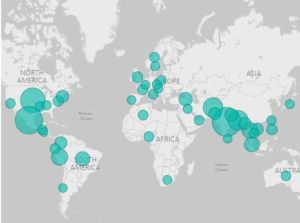
A 28-day heat map of where FIFA’s digital team has engaged with its fans (Photo via @AlexStone7)
A few other top-performing posts early in the tournament included the graphic following Mexico’s stunning defeat of Germany (which reached 16.2 million people on Facebook), the video of Chucky Lozano’s goal on Instagram (which accumulated approximately 2.4 million views), and a photo of Mo Salah’s arrival in Russia (which generated 1.16 million reactions, comments, and shares on Facebook).
Russia’s shocking upset against Spain in the knockout rounds caused unprecedented traffic on FIFA’s VK account. After the win, VK content reached over 9.5 million unique users across the platform, which is almost 10 percent of VK’s 97 million monthly active users. This number is remarkable as four years ago, during the 2014 Sochi Olympics, content reached 10 million unique users for the entire month of February.
Want more content like this? Subscribe to our daily newsletter!
Following the dramatic commencement of the group stages and the start of knockout rounds, which has already seen strong teams like Argentina, Portugal, and Spain eliminated, the FIFA team has had plenty of interesting stories to tell.
In the remaining weeks of the World Cup, history will be made — and not just on the field. With the online audience larger than ever, expect new records to be broken on social as we continue down the path of determining the world’s next champion.