

How ESPN Will Use Chris Berman in Its Super Bowl Coverage
Want more from Front Office Sports
in your search results?
In November, around hour three of a five-hour flight to Miami, Cal women’s volleyball head coach Jen Malcom was sitting comfortably enough when the overhead P.A. crackled on.
The restroom toilet had flooded. Flooding meant potential damage to landing gear. Potential damage to landing gear meant an emergency landing in Dallas.
A previous life, playing in the Pac-12, did not often present these kinds of hurdles. But this was a new era. And so Malcom and her assistant frantically began texting their travel agent, now needing to figure out how to transport around 20 members of her volleyball program from Dallas to Miami to Tallahassee for the next day’s Nov. 1 ACC match at Florida State.
There were no more flights available by the time Cal finally landed in Miami that evening. In the airport, Malcom gathered her team and delivered the news: They would in fact have to take a bus to Florida State. “I was like, ‘All right, this is the moment of adapt and adjust,’” Malcom recalls telling her team in the Miami airport. “‘Here we go.’”
And all because of a busted toilet, Cal women’s volleyball rode through Florida for eight bleary-eyed hours, and they arrived in Tallahassee 12 hours before their 6:30 p.m. game. They lost in three sets.

Maybe it was the toilet’s fault. Maybe it wasn’t. “I think the lack of sleep probably had a little bit to do with it,” Malcom tells Front Office Sports. “But again, there’s nothing that we could do about it.”
The past months have brought plenty of moments of “adapt and adjust” for Cal and Stanford since their landmark move to the ACC—two longtime Bay Area titans now facing the realities of a conference schedule in a conference headquartered in Charlotte, N.C. According to data mapped and analyzed by FOS, Cal and Stanford fall sports programs both traveled around 65,000 miles farther for ACC play than in the Pac-12 in 2023.
The mileage, too, comes at a price. Cal’s acting CFO, Josh Hummel, estimates the single-year increase in travel costs from joining the ACC is upward of $1 million. Both programs have invested considerable resources and manpower into minimizing the effects of travel on college athletes—with fall programs’ “guinea pigs,” as junior Ava Mehrten puts it, for experimentation in a new conference.
“Really, it’s kind of amazing, because I feel like we’ve been in the ACC for 10 years now,” Hummel says of Cal’s preparation. “But we’ve been there for like, four months. And I realize that half of our sports haven’t even experienced this yet.”
At some point amid the mess of that trip to Tallahassee, Malcom texted Cal’s basketball staff. All of them, after all, were now banded together in this trial-and-error era of realignment. “Make sure you charter to Florida State,” she wrote to them, as she remembered. “Just in case.”
In the summer of 2023, when Cal was engrossed in discussions with the ACC on conference realignment, the “biggest thing in mind” was the travel impact, as Hummel says.
ACC leadership requested both Cal and Stanford consult their college athlete bodies to determine whether the move would be a positive one, and had a variety of conversations with university athletic committees and coaches, according to an ACC spokesperson. And widely, Stanford and Cal’s college athlete leadership groups expressed their top priority in finding a new conference was to maintain a high level of competition.
“I was never frustrated with anything because most of it was out of our control,” Stanford’s Elia Rubin, a junior on the women’s volleyball team, says of the conference shift. “And I know that the decision for us to move to the ACC was, like, totally with our best interest in mind. So, I never doubted that.”
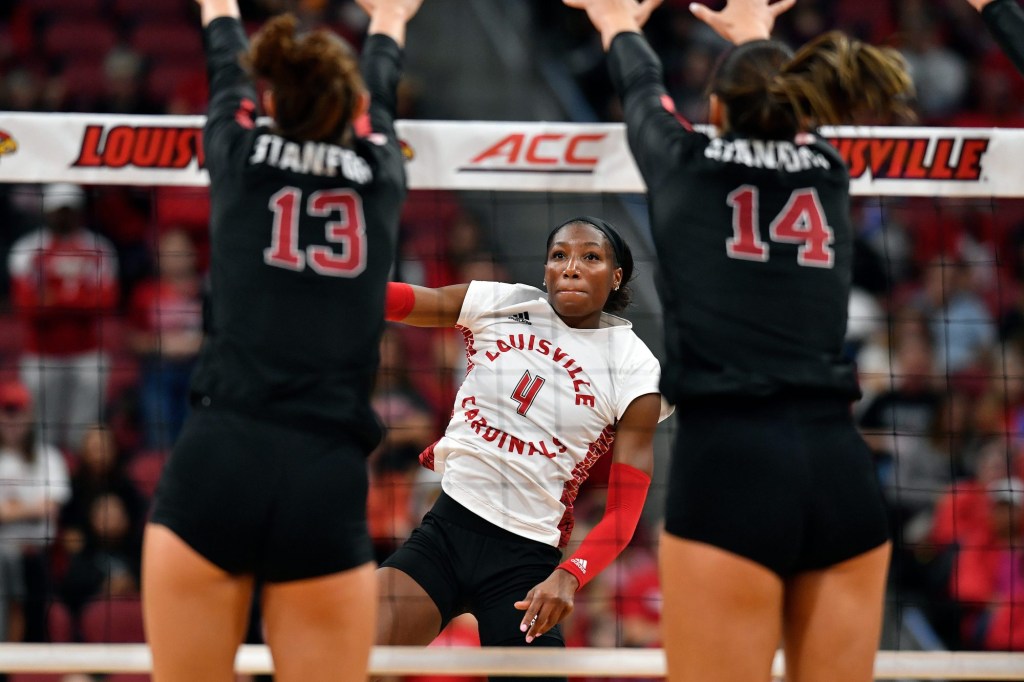
The ACC was “amenable” to Cal’s feedback in designing a conference schedule, says Hummel, with the high-academic Bay Area schools placing an emphasis on minimizing missed class time. Sunday games for Cal women’s volleyball were scheduled in the afternoon, providing time to fly back out in the evening and return before school Monday. Cal women’s tennis will play at Virginia and Virginia Tech in late March, and then stay on the East Coast over spring break to play Miami and Florida State, knocking out two road games without any class absences.
Cal women’s volleyball, Malcom says, chose to leave on Thursday for Friday-through-Sunday East Coast trips, specifically to keep a full day of classes Wednesday unaffected. They would hold study-hall periods on longer commercial flights. Players would download their readings as PDFs. One player even took a quiz mid-flight.
When they got stuck on that eight-hour bus to Tallahassee, Mehrten shrugged it off. “I was like, ‘You know what? More time to do my work, anyways.’”
Navigating the roles of student and athlete, though, hasn’t always come so easily. Four days after Cal’s lavatory fiasco, Stanford had its own Tallahassee nightmare: The team got stuck in Dallas as their layover coming back from a match at Florida State was delayed three hours. By the time they’d landed back in the Bay Area, Rubin said, it was 3 a.m.
They got back to their dorms, Rubin says, around five that morning. Half the team had midterms four hours later. “It was pretty bad,” Rubin says. “But it could’ve been worse, we always kept saying.”
A couple of times throughout the fall, Rubin thought, “We’re in an airport more than we are anywhere else.”
Stanford’s first extended conference trip involved a four-hour plane ride followed by a four-hour bus to Notre Dame, pulling into campus in Indiana for a practice at 10 p.m. Their second trip was originally scheduled for a return flight after a Wednesday game at SMU, and then another flight back out Friday for a game at Pittsburgh on Sunday, before players advocated they simply stay on the East Coast the whole week. Their third trip was the Florida State struggle; it was then, Rubin says, that the players and coach Kevin Hambly felt the need to advocate for more charter travel to administration.
“We’re not a revenue-generating sport, so we just wanted to know, like, what was possible to kind of make some situations as good as possible,” Rubin tells FOS. She acknowledged there was only so much that the administration could do.
Women’s volleyball, indeed, will have likely the toughest go in ACC travel for any fall or winter sport. Cal women’s volleyball chartered two flights, and flew commercial for the rest, across four total road trips; football and men’s basketball charter every road trip, Hummel confirmed.
But across a wide variety of programs, both Cal and Stanford have put heavy resources toward athletes’ sleep and nutrition on road trips. Malcom spoke with a sleep expert to consult on Cal women’s volleyball, and the team developed a hyper-specific in-flight routine. Some would wear freshly purchased Normatecs—bulky compression boots—and use heated back massagers on flights. All wore special glasses on flights, Mehrten says, to help protect their eyes from phone blue-light rays and ensure they could drift off in-flight. They scheduled what Mehrten called “caffeinated naps,” where players would drink a coffee, go to sleep for 20 minutes, and awaken to theoretically increased awareness.

Stanford women’s basketball, meanwhile, has been working with consultant Susan King Borchardt, a former program alumn who now works as a performance specialist. The team wears specialized tights on flights, head coach Kate Paye says, and staff monitor players’ hydration.
The planning, though, “isn’t rocket science,” Paye tells FOS. Her players, ultimately, are excited to compete in the ACC, she emphasized—a sentiment echoed by Cal’s and Stanford’s coaches and players alike, despite the mileage.
“Do we have a strategy to handle the travel?” says Paye, whose program is 9–7 in her first year as head coach after the retirement of Tara VanDerveer. “Yes, we do. Are we fixated on it? No, we’re not.”
With only a few months of evidence and observation, there are still many kinks of this new reality to work out. Stanford’s freshmen in 2024–2025 had never experienced the previous world of Pac-12 travel. Throughout the fall’s long road trips, Rubin says, the newcomers would ask: “Is this how it’s always going to be?”
“We’re like, ‘Well, it’s how it’s always going to be for you guys.’”
Editor’s Note: An earlier version of this story incorrectly stated Stanford does not field a men’s soccer team.
Download the FOS App
The business of sports, in your pocket.



Scan the QR code to get the app now.