Want more from Front Office Sports
in your search results?
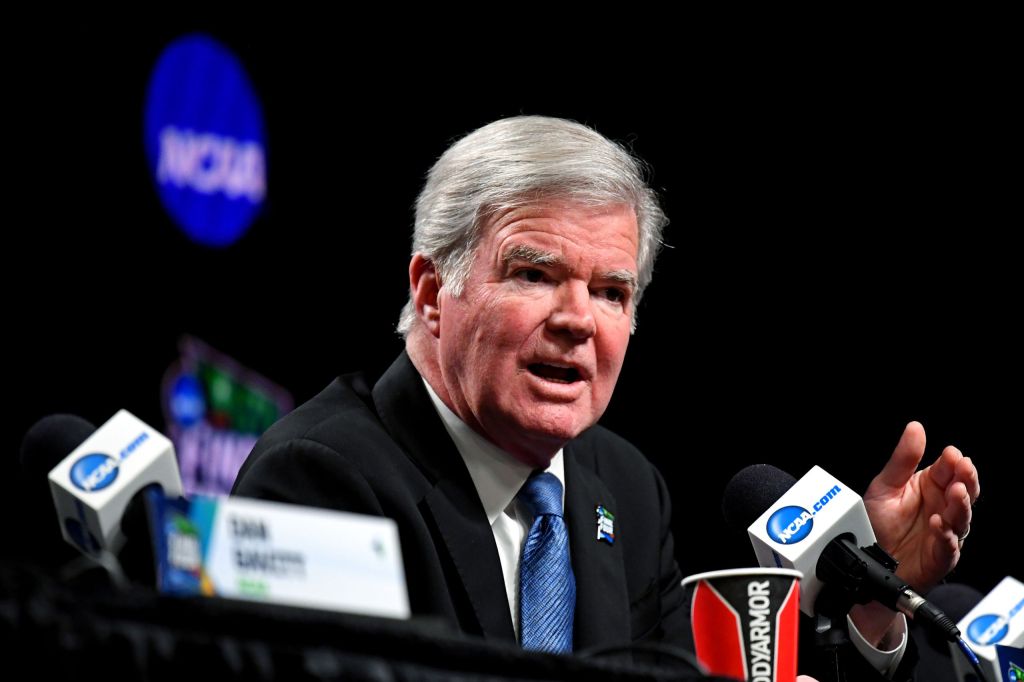
WASHINGTON, D.C. – The conversation surrounding name, image and likeness in college athletics continued on Capitol Hill on Tuesday as chairman Sen. Jerry Moran, R-Kan., and his subcommittee heard from NCAA president Mark Emmert and other college administrators during a Senate hearing on the state of student athlete compensation.
After California passed a law in September allowing athletes to profit from the use of their name, image and likeness, more than 25 states have either passed or begun working on similar legislation. Congressional action could eventually supersede the states’ laws if actions taken by the NCAA are not seen as sufficient.
The witnesses were met with skepticism from Senators critical of the current state of affairs, as well as from others testifying including Ramogi Huma, executive director of the National College Players Association and former UCLA football student athlete, and Kendall Spencer, chair of the NCAA’s Student-Athlete Advisory Committee and former University of New Mexico track student athlete.
The Senators did, however, express a hint of understanding regarding the complexity of the issue at hand, while agreeing that the patchwork of state-by-state laws currently being put into place would be a “nightmare,” if implemented.
“The question before us today is: how can we prevent state by state chaos and protect the collegiate athletics system that is beloved across the nation,” Rep. Anthony Gonzalez, R-OH, a former football student athlete at Ohio State, said in an opening statement.
The current state of change raises concerns for all parties about a lack of uniformity creating an inequitable college landscape. But the consensus collapsed surrounding discussions of immediate action, timeline and what counted as fair compensation for the players at the heart of this heated debate.
Senators from both sides of the aisle questioned the NCAA’s overarching goals and the impact of potential rules changes on all athletes. They also called out the NCAA’s desire to keep decision-making in its own jurisdiction despite their heavy lobbying efforts.
“To be honest with you, you don’t want us to solve this,” Sen. Jon Tester, D-MT, said. “You want us to help you solve this.”
This week, the Associated Press reported that the NCAA spent $690,000 last year lobbying lawmakers in Washington. Rep. Mark Walker, R- NC, who introduced a bill earlier this year that threatened the NCAA’s tax-exempt status, has said previously that “there’s no question” the NCAA’s lobbying has been effective, yet organizations that represent student-athletes have not paid lobbyists.
Both Moran and ranking member Sen. Richard Blumenthal, D-CT, called out the unsatisfactory status quo within the college space. The congressional duo advocated for decisive action to be taken by the NCAA to support those same student-athletes and prevent the impending chaos that will come if individual state legislation stands.
READ MORE: SEC Schools Begin to Answer Million-Dollar Question About Alcohol Sales
“We should ensure [student-athletes] receive equitable compensation for their hard work and the value that they create,” Blumenthal said. “College athletes receive no remuneration, no compensation, no financial recognition at all. That has to change.”
Despite his hesitation to take NIL changes as far as some want it to go, Emmert did acknowledge the need, saying “the NIL law that’s in place needs to be modified and is appropriate for change.” While his admission was appreciated, Senators were still dissatisfied with the pace of his approach to accomplishing such an overhaul.
Blumenthal pointed to college sports as a $14 billion industry annually which makes “massive” amounts of money for both the NCAA and its member schools, none of which is funneled to the student athletes. They have the means to make something happen.
“In short, everyone is profiting off the name, image, likeness and accomplishments of college athletes instead of the athletes themselves,” he continued. “And it’s during a period when their prowess and earning capacity might be at its height.”
Despite calls to consider significant change, Emmert held steadfast to his longstanding assertion that paying athletes would deconstruct college sports as an entity separate from the professional realm. The NCAA’s position remained that amateurism is required to maintain a competitive environment in college sports.
“We believe it is imperative to the success of college sports as both an integral component of the educational experience and a popular form of entertainment that we maintain a clear line of demarcation between college and professional sports,” Emmert said in a statement.
Emmert added that the name, image and likeness laws in place would go beyond compensating athletes and have a negative impact on recruiting, acting as potential inducements.
He continued: “The NCAA has no intention of taking any action that is contrary to the position advocated by the NCAA or accepted by the Ninth Circuit with respect to the types of NIL payments that were at issue in the O’Bannon case decided a few years ago.”
O’Bannon, Five Years On
In the O’Bannon case, the United States Court of Appeals for the Ninth Circuit ruled in 2014, in part, that amateurism is an essential component of college sports and that NCAA schools should not be forced by the courts to provide benefits not connected to education. The decision reversed the ruling of the lower court that colleges must give men’s basketball and football players up to $5,000 per year for the use of their name, image and likeness.
The ruling did, however, find that the NCAA’s compensation “rules were an unlawful restraint of trade.” Certain rules implemented to maintain the tradition of amateurism and a level playing field in the college sports market were found to be more restrictive than necessary, violating federal antitrust law. The result was a cost-of-living stipend which expanded the NCAA’s offerings to student athletes to the complete cost of education.
The issue for some is that, as Huma pointed out at the hearing, the judge in the initial O’Bannon case already came to the conclusion that competitive equity in the NCAA is a myth. Disparate revenue from television contracts, boosters, and other sources, he argued, have already negated competitive equity – the entire basis of the NCAA’s argument for limiting NIL legislation.
READ MORE: Maryland, Pitt Add Their Names to Continuing College Athletics Facilities Arms Race
“From the wins and losses, from the economic analysis, it’s very clear that there’s data, there’s evidence all over the place showing that the Power 5 conferences are winning the best recruits [and] winning the most games,” Huma said. “So when you’re talking about closing the door on players’ economic freedoms by way of capping their opportunities or limiting their sources of opportunities, it’s not consistent with the fact that the NCAA has already allowed this inequity to go on for decades and decades and decades. They don’t see that as a problem.”
Huma cited alternative ways to level the playing field during the hearing, namely revenue sharing or banning booster payments, which differ dramatically from school to school.
“They don’t want to do that,” he said. “If they don’t want to do that in terms of trying to level the playing field, then it is hypocritical to try to take players opportunities away from them, especially the ones being extended by the states,” Huma said.
States Line Up
Concerns raised regarding the NCAA response to individual state legislation and the contradictions Huma touched upon aren’t exclusive to the organization’s handling of NIL legislation. It extends beyond that, Sen. Marsha Blackburn, R-TN said, and is the result of an overarching trust issue.
“We’re looking at a time when the NCAA has failed,” Blackburn said. “I think a question that’s going through the minds of a lot of parents and students is ‘How and the world are we supposed to trust you?’”
The Senator cited the suspension of former Memphis freshman and projected first-round NBA draft pick James Wiseman as an example of the NCAA’s “lack of transparency, and a lack of consistency and a lack of fairness” which she argues extends to the name, image and likeness debate.
Tennessee is one of more than 25 states across the country to have introduced similar legislation at the state level, following California’s lead. More are expected to follow. In response, the NCAA announced in the fall that it was crafting rules that would allow college athletes to earn NIL compensation.
The organization is in the ongoing process of working out the details of how that would take place and will vote on new bylaws in 2021, as Emmert reiterated, after the NCAA working group gives its recommendations in April. He did not, however, provide answers about immediate changes that could be implemented prior to 2021, with states like Florida set to enact their own state NIL laws as soon as this summer.
Even with potential answers on the horizon, not all who spoke Tuesday are confident that NCAA leadership alone will enact sufficient change, despite Moran’s emphasis after the hearing that Congress will not get involved if the NCAA does its job.
“I wish we would have heard about a process that was quicker, more timely,” Moran said after the witnesses finished testifying. “I would like to see the NCAA and their athletes, through a process that includes athlete participation, reach a conclusion. I didn’t hear today that that’s on the immediate horizon. But we’ll see what they’re able to present us in April and how firm, how concrete, how solid those policies are.”
Congressional legislature should be a last resort as it relates to action on the subject of NIL, but lawmakers may have to step in if they remain unsatisfied with the strides being made.
“A lot of what I hear from the NCAA and coaches and college officials [about NIL] evokes the fantasy of college sports as it existed 50 years ago,” Blumenthal said. “I think that a lot of what we hear about college sports is as antiquated as leather helmets. And that makes me angry.”
Blumenthal called upon Congress to step in where he sees the NCAA taking inadequate action.“We have the responsibility, especially in the absence of leadership elsewhere,” Blumenthal said. “But I hope there will be leadership in the NCAA.”
Download the FOS App
The business of sports, in your pocket.


Scan the QR code to get the app now.