Want more from Front Office Sports
in your search results?
Editor’s Note: Bryan B. Blair is the deputy director of athletics and chief operating officer for Washington State University. The views expressed in this commentary, which was written on Aug. 6, are his own.
Where Do We Go From Here?
My Why
The past several months have sent many of us on a rollercoaster of emotions. I’ve gone from feeling fearful, to angry to hopeless to optimistic and back into a jumbled loop. This loop ends just as it begins for me each time, with more questions than answers.
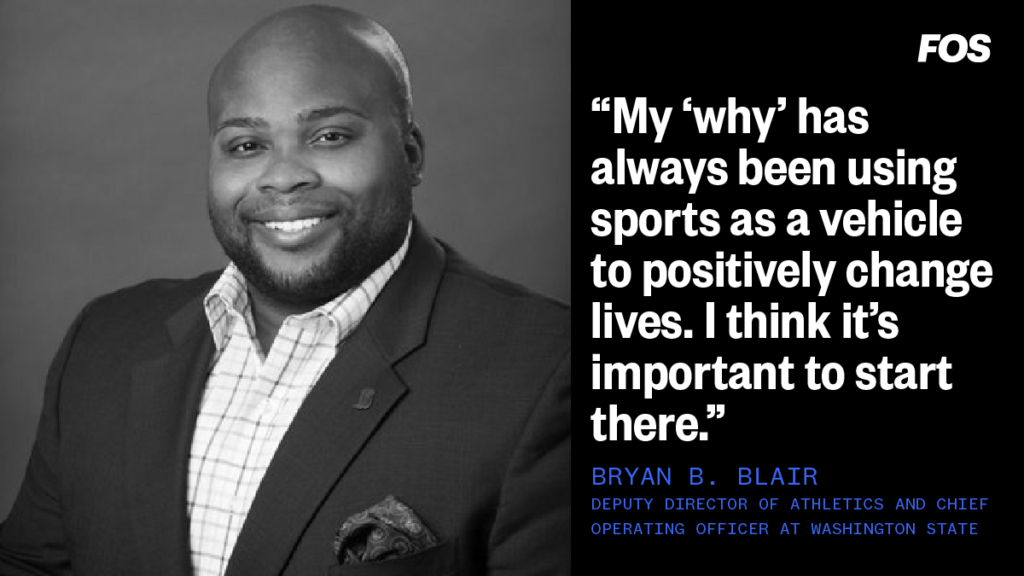
My “why” has always been using sports as a vehicle to positively change lives. I think it’s important to start there, because it’s easy to get distracted with the “perfect storm” our country and college athletics are currently facing, be it a global pandemic, the social justice movement, or even the right to their name, image, and likeness. Without knowing your WHY, it’s impossible to determine the HOW or WHAT as you navigate these challenging times.
My why stems from my upbringing. Growing up in rural South Carolina as the son of two educators, I knew three pretty clear truths:
- I loved sports.
- A dedication to education was a requirement to access sports (per my mom aka the original NCAA Clearinghouse).
- Many aspects of my life and those of my white counterparts were very different.
Ironically, it was education that reinforced this notion.
My mom made sure I was in the “gifted & talented” or honors classes all the way from middle school until high school. Being the only or one of a few minorities in those settings provided a daily lesson on how different my world was growing up compared to my white classmates. Over the years, I learned how to navigate that experience, and unfortunately learned how to cope with the feelings of isolation and loneliness that came with it. It wasn’t until many years later that I realized the racial and socioeconomic disparities that led to me being one of those few.
Where I grew up, the races were often separated, from where they lived to where they socialized. The one space everyone came together was sports! This reality clicked for me at an early age and remained with me as I entered a career in college athletics. Seeing people from all walks of life high fiving and hugging after a touchdown was a powerful sight. On those Saturdays in the fall, everyone of all colors, shapes and sizes comes together to worship in the house of football, but the next morning they often go to completely different churches on completely different sides of town.
Ultimately, my why is based on the transformative power of sports: its ability to unify diverse groups, to change the life of a young person that would never access higher education, but for, college athletics, and the way young people often look up to our athletes as quasi-superheroes. As Nelson Mandela once said,
“Sport has the power to change the world. It has the power to inspire. It has the power to unite people in a way that little else does. It speaks to youth in a language they understand. Sport can create hope where once there was only despair. It is more powerful than government in breaking down racial barriers.”
I don’t point to my why as the answer to all of our nation’s problems. Far from it. I’ve run into many issues such as the time a high school teammate said I couldn’t come over to his house after school because his dad didn’t like Black people, or being stopped numerous times by campus police and asked for my ID, despite them cheering for me on Saturday’s when I sported my helmet and school logo.
These incidents have been constant reminders that some people in the world see me as less than and/or a threat based on the color of my skin. If you asked many of those white teammates or classmates about that fact of my life, they may tell you everything between the races was fine. This is the same thing many white southerners said when asked to desegregate. Everything was fine…for them.
I wish I could say these incidents disappeared once I graduated from law school, or once I rose through the ranks of college athletics, or once I moved to new parts of the country. I’ve lost count of how many times I’ve walked into a meeting with a colleague and it’s automatically assumed I work for the other white male colleague. Similarly, I tend to “overdress” because I’ve noticed how differently I’m treated when just wearing a polo and khakis like many of my colleagues. There is also the fear of checking the mailbox in our subdivision at night so as to not startle neighbors and Googling “racism in ____” before going on a vacation. This is my reality.
I am a positive person and don’t believe in dwelling on the negative. Over time, you normalize these incidents. “That’s just the way things are.” “That’s my plight in life, no sense in complaining.” You even joke about them with your friends to lessen the sting. Frankly, I still have doubts that real, systemic change will come. Will we be having the same conversation years from now?
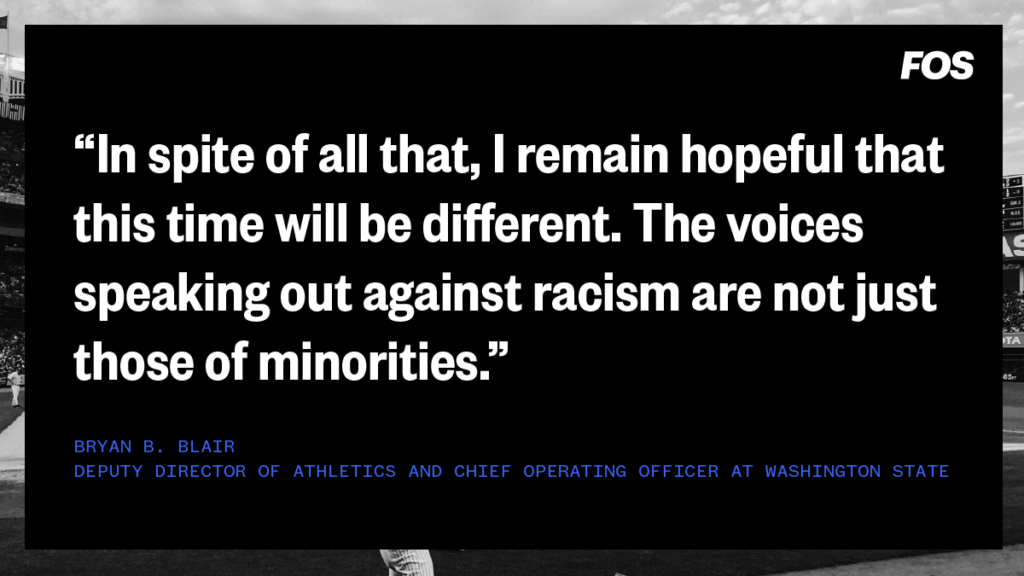
In spite of all that, I remain hopeful that this time will be different. The voices speaking out against racism are not just those of minorities. The combination of quarantine and video evidence put these latest murders in front of the nation’s face in a way we couldn’t scroll past. In some ways, it was similar to the 1955 open casket funeral of Emmett Till, which is often credited as starting the civil rights movement.
So, I ask myself: How do I do my part to make sure this time is different?
Leadership Challenges
What should I do?
How do I speak for every Black person in the organization?
How do I digest my own feelings, while helping others?
Who do I turn to when I’m not okay?
These and many others are the questions your Black colleagues are asking of themselves. Many of us are exhausted. We have been given lip service and meaningless symbolic gestures in the past. Once, I brought up the lack of diversity on a new coaching staff to a senior administrator and was told that they planned to hire “one,” to help with recruiting.
Why didn’t he see that as inappropriate or that it completely dismissed my concern?
The thought that the only value a Black staff member has is recruiting, or any number of other roles that don’t typically advance to leadership positions, is problematic as it perpetuates a stereotype and demonstrates why we’ve made minimal progress between the percentages of Black athletes and the coaches and staff that serve them.
So, I ask myself: If I don’t step up and lead, who will?
How Do We Progress?
So, how do we make sure this time is different? I don’t believe in bringing a problem to the table unless you have a solution. My proposed solution falls into three buckets:
Educate. Act. Track. (EAT)
- We must educate. We need to listen and learn, but maybe not in the traditional format. We have more resources at our fingertips than ever. I applaud Rice AD Joe Karlgaard for his weekly blog covering the resources he’s finding and using. We must educate ourselves rather than relying on others, particularly members of marginalized groups, for all of the answers.
Also, let’s not just bring an annual speaker in and check the box. Let’s develop ongoing conversations between staff and student-athletes, sharing thoughts and experiences. Oftentimes, racism is equated to love vs. hate, which usually doesn’t include important topics such as microaggressions and systemic racism. I believe personal discussions with people you know and care about help drive many of these points home. The negative experiences I’ve outlined and countless others happen to people of color you know, regardless of title, education level, the way they talk or any other factor aside from the color of their skin. In addition, these discussions also bring the entire department together, fostering a more inclusive and close-knit culture.
- We must act. Actions > Words. Don’t worry about saying or doing the “perfect” thing, get to work. We all have resources on our campus and in our community to assist these efforts. About two years ago, I asked my athletic director, Pat Chun, if we could send student-athletes to the Black Student-Athlete Summit in Texas. Without blinking or asking how much it cost, he said yes and we’ve been sending representatives every year since. After that initial step, we’ve seen the formation of our Black Student-Athlete Association led by five amazing student-athletes, and a Diversity, Equity & Inclusion (DEI) Council, which includes over 15 staff members of various races, genders, nationalities, etc., including our AD and SWA. Although we have a long way to go, I’m very proud of the steps we have taken to move the department forward.
- We must track. What gets measured, gets accomplished. It’s one thing to launch committees or proclaim core values, but it’s another to set measurable goals and achieve them. It is fairly easy to measure the diversity of your staff and student-athlete populations. However, it’s important to look at your leadership roles, senior leaders, department heads and head coaches. When those vacancies come up, what do the candidate pools look like? Be proactive before an opening exists, build new relationships, and measure your progress.
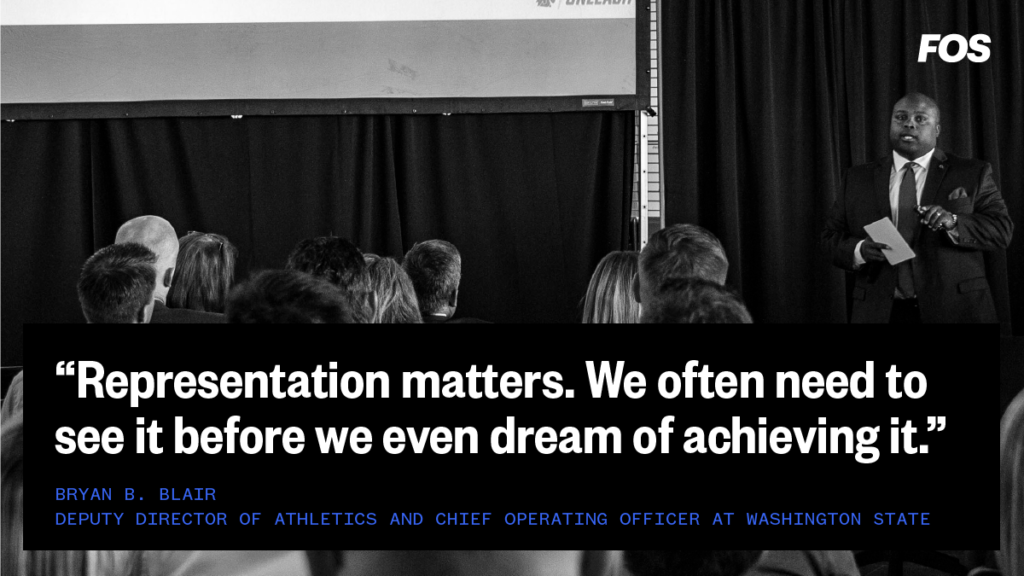
Representation matters. We often need to see it before we even dream of achieving it. I once had an administrator tell me that we should hire the best person and diversity is a “cherry on top” if it ends up that way. While I agree on hiring the best person, I don’t believe diversity can be so easily discounted, especially as you consider the makeup of the entire organization and the stakeholders (e.g. student-athletes, fans, community, etc.) it serves. For those working in college athletics, the Minority Opportunities Athletics Association (MOAA) is doing great work to advocate for increased participation and administrative opportunities for minorities in athletics.
Lastly, if you need guidance, there are a number of professional organizations that can help conduct cultural assessments of your employees and organization, while assisting you with developing measurable next steps. One of the first and best that comes to mind is Vince Pierson, given his years of experience working as a DEI expert in the sports business. The Ross Initiative in Sports for Equality is also doing valuable work in this space and has assisted a number of organizations and athletic departments.
So, I ask myself: What if people don’t want to understand? What if they refuse to act beyond a PR statement?
Closing
Candidly, I was hesitant to write this article. I agreed to do it once approached by Front Office Sports, but as the weeks passed, I had a blank page and was still asking myself the same questions:
- Is my story worth sharing? Every Black person in America could give similar examples.
- Can I successfully articulate 35+ years of experience, frustration, hopes and dreams in 500-1,000 words? [simple answer: no]
- Will expressing my truth eliminate future opportunities to chase my dreams? If so, do I bite my tongue now with the hope of one day securing a position that serves as a beacon of hope to future generations?
I still don’t have the answer to these and countless other questions, but I do know my why. My why is the reason I got into sports and it is the reason why I remain hopeful in these turbulent times. It is the reason I ultimately chose to write this article.
As the recently deceased civil rights legend, John Lewis said, “You are a light. You are the light. Never let anyone — any person or any force — dampen, dim or diminish your light. Study the path of others to make your way easier and more abundant.” I hope my words serve as a light, and my path makes the way easier and more abundant for future generations.
So, here is my final question:
Where do we go from here?
Will we create meaningful change, or will this be another wave of short-lived hashtags and symbolic gestures?
The choice is mine. The choice is yours. The choice is ours.
Download the FOS App
The business of sports, in your pocket.



Scan the QR code to get the app now.