Want more from Front Office Sports
in your search results?
Amateurism, or at least the NCAA’s version of it, is dying. Between several federal court and National Labor Relations Board cases, the NCAA could be anywhere between one and five years away from its business model being completely struck down, with athletes being deemed employees with the right to unionize.
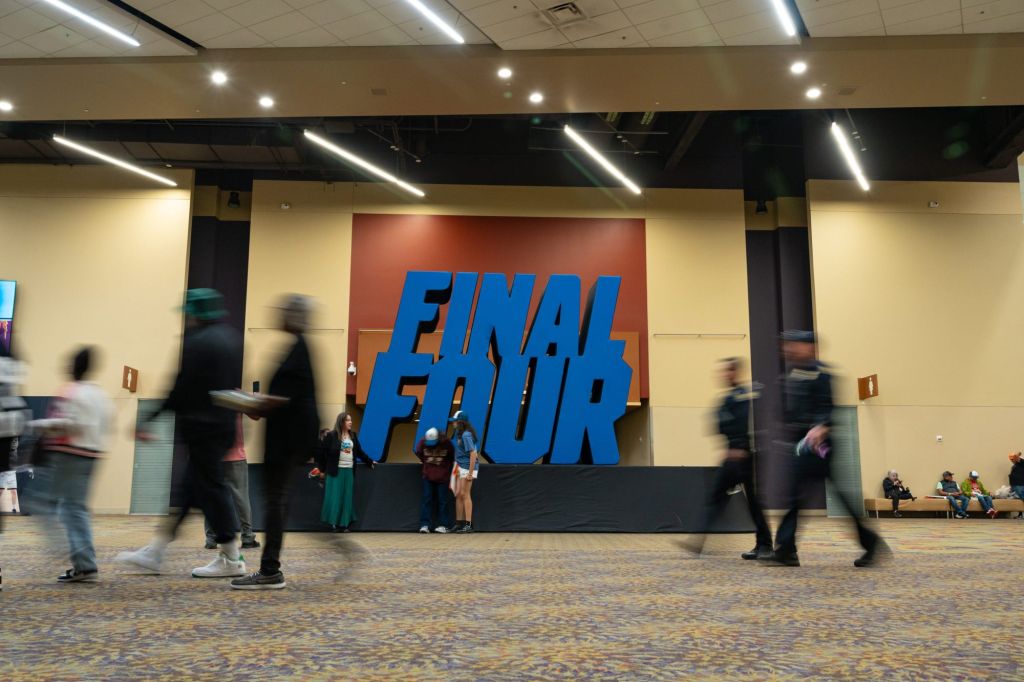
But at this year’s men’s Final Four in Phoenix, the conversations about college sports’ existential crisis amounted to little more than a whisper. This weekend, there were only two publicly announced events related to it, and neither of them received major fanfare. Coaches chatted about the prospect of employment, but there were no official proposals addressed, one source tells Front Office Sports.
That’s surprising, given that the event is much more than just a three-game slate and a set of fan activities. It’s also a giant hub of conferences, business meetings, parties, and general schmoozing for the multibillion-dollar college basketball industry. There’s networking at dinners and parties, commissioners flying back and forth between the men’s and women’s tournaments, a major coaching convention, and broadcast executives from top networks taking meetings with administrators. It’s supposed to be the place to address all the biggest issues.
Almost no one, though, wanted to talk about college sports not being considered amateur, even as this weekend had all the glitz of a professional event. There were basketball games, played by people not paid to do so, in an 80,000-seat football stadium. There was the sunny resort hosting coaches, executives, and administrators, complete with a pool, an outdoor bar lined with blue fountains before the games, and celebrities like Trevor Lawrence popping into the hotel ice cream shop. There were the agents hustling behind the scenes, taking as many meetings as they could.
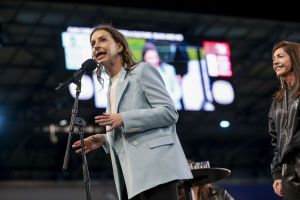
One rare event that did acknowledge the changes on the horizon took place at Arizona State University on Thursday evening. The ASU Humanities Institute presented an award to Ramogi Huma, a former UCLA football player and founder of the National College Players Association who has been directly involved in almost every major NCAA athlete compensation reform in the past 20 years, including name, image, and likeness and the 2014 Northwestern football unionization effort. He’s currently leading an unfair labor practice case against USC, the Pac-12, and the NCAA that could result in Division I football and basketball players nationwide being deemed employees.
The event, moderated by ASU sports historian and college sports expert Victoria Jackson, touched on Huma’s personal and professional journey as a college athlete advocate, the main issues of safety and pay that he hopes to address, and the NCAA’s talking points he believes are false. (For example, he disputed the idea that women’s and Olympic sports wouldn’t have to be cut if schools paid some players by pointing to lower-division and high school sports that have robust athletics programs without nine-figure budgets.) It was well attended by curious students and faculty, but no athletic department employees were there. Huma himself flew home Friday after the engagement ended.
Huma has long been an outsider in college sports, which is perhaps why he is one of the biggest reasons it has changed. He said he believes real change can only come from outside the NCAA, school, and conference orbit. That’s why he’s more likely to enlist lawyers, lawmakers, or the U.S. Department of Justice (which he affectionately dubbed “the antitrust police”) to chip away at amateurism.
The second event was hosted by the National Association of Basketball Coaches, which hosts a convention every year at the men’s Final Four.
Student Athlete NIL’s Jason Belzer and Athletes.org’s Jim Cavale led a conversation dubbed “Now It’s Legal: The True Value of Student-Athletes and The Impending Reality of Player Compensation.” Cavale is one of several advocates working to organize college athletes through his new organization Athletes.org, but he’s taking a much more insider approach than Huma, given that AO is looking to work with college athletics leaders—including on its board.
Outside this event, there was no other formal discussion for coaches, at least, one source says. But they did chat informally about the concept throughout the weekend, mostly asking a litany of questions. What would employment look like? What are the pros and cons? Would it help the legal environment? Coaches were looking to get educated, though the topic was hardly described to FOS as the most pressing issue.
Cavale agreed that, by and large, there is very little conversation happening about the potential death of amateurism. He blames the lawyers.
“It’s interesting how much liability is referenced by college athletics leaders when you bring up topics like employment or unemployment, and you bring up topics like revenue sharing, and you bring up topics like athletes organizing,” Cavale says. “There’s a lot of sensitivity in public forums, especially by college athletics leaders, because of the ‘risk’ they have in talking about these things and how even things they say in a private conversation could be used in a deposition.” In other words, general counsels at universities have warned athletic departments against saying anything about enhanced athlete compensation, employment, or unionization, because those comments could be used against them in one of many ongoing legal battles threatening amateurism.
The risk is very real: NCAA president Charlie Baker’s “Project DI” proposal, which suggests revenue sharing for certain athletes, has already been used against the governing body in federal litigation at the NLRB. But Cavale thinks the lack of conversation is a mistake. “That risk is not as big as not figuring out the future.”
Download the FOS App
The business of sports, in your pocket.



Scan the QR code to get the app now.