|
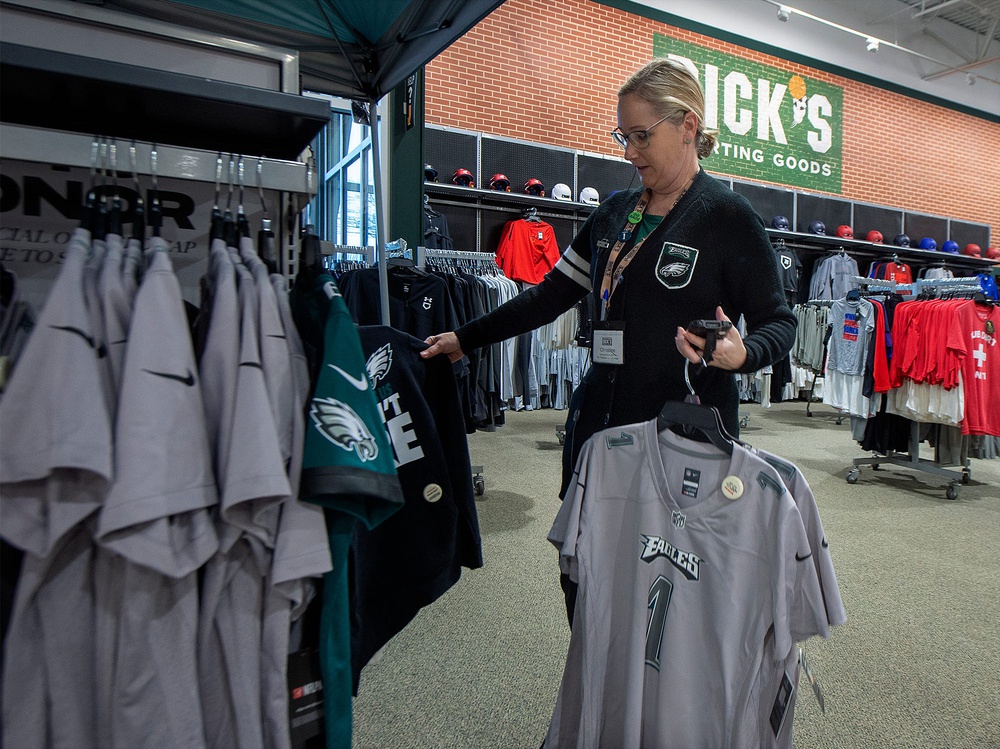
Dick’s Sporting Goods is buying Foot Locker in a $2.5 billion transaction aimed at creating a “global leader in the sports retail industry,” but experts say the deal underscores just how far Foot Locker has fallen.
The deal sees Dick’s paying $24 per share for Foot Locker, which represents a more than 85% premium over the $12.87 per share closing price of Foot Locker stock Wednesday, and a roughly 66% premium over the company’s average share price over the last two months. In comparison, shares of Dick’s have been performing much better, despite taking a hit on the Foot Locker news. Shares of Foot Locker stock soared by almost 85% Thursday.
Dick’s shares closed down Thursday more than 14% at almost $180 per share.
The agreement comes amid a turbulent market fraught with uncertainty, thanks in part to questions surrounding President Donald Trump’s tariff policies, but experts—unlike with the recent megadeal taking Skechers private—don’t view tariffs as a main factor behind this deal happening when it did.
“I think the stock price tells you why now,” retail analyst Jane Hali of Jane Hali & Associates tells Front Office Sports.
In Foot Locker, Dick’s picks up a business with about 2,400 retail locations across 20 countries. The deal expands the Dick’s footprint internationally, as it currently has about 850 locations, all in the U.S. The plan is to keep Foot Locker operating as an independent business, according to a Thursday statement.
The agreement comes the same day Foot Locker and Dick’s each issued statements outlining preliminary results for the first quarter of this year. Dick’s boasted comparable sales growth of 4.5%, which beat estimates from investment bank UBS. Dick’s CEO Lauren Hobart said in a statement that the company is “very pleased with our strong start to the year and our demonstrated sustained growth.”
Matt Powell, a footwear and retail industry expert who heads up consulting firm Spurwink River, agrees with Hobart’s positivity. “Dick’s is on a roll right now,” he tells FOS.
Foot Locker, on the other hand, was more subdued in its earnings statement. The company said comparable sales decreased by 2.6% from the prior year, and it noted an expected net loss of $363 million.
Foot Locker CEO Mary Dillon said in the statement that “our preliminary first quarter results are below our expectations as we experienced softer traffic trends globally.”
Telsey Advisory Group analyst Cristina Fernández tells FOS that Foot Locker’s struggles are nothing new. “Foot Locker has been in a turnaround for many years,” she says. “Even pre-pandemic there was concern of it being too dependent on Nike.”
Both Foot Locker and Dick’s do plenty of business with Nike, but to very different degrees. Powell says Nike represents about 60% of Foot Locker’s business, whereas for Dick’s it makes up about 25% of the company’s business.
“The biggest issue for Foot Locker is the exposure to Nike,” Powell tells FOS.
Once the merger is complete, the Nike exposure for Dick’s will rise to about 40%, he says. “There’s some risk there, but Dick’s, operationally, is better than everybody else in the industry,” Powell says.
For its part, Nike is staying neutral. “Dick’s Sporting Goods and Foot Locker are two of the most storied and respected brands in our industry and have been our valued partners for decades,” Nike CEO Elliott Hill said in a statement. “I am confident that together, they will help elevate sport and continue to accelerate the growth of our industry.”
Will Regulators Take Notice?
Other than Academy Sports, which mostly competes with Dick’s in the southern part of the country and some small specialty or niche retailers, Dick’s doesn’t face all that much competition in the U.S. The companies that used to be rivals—Modell’s, Sports Authority, Olympia Sports—have all gone out of business, thanks in part to difficulties running a successful retail business with a large brick-and-mortar footprint in the age of online shopping.
“There used to be a fairly big stable of regional sporting players, but most of those are gone,” Powell says. “In many ways, you can say Dick’s doesn’t have competition other than Academy Sports.”
Does that mean this deal could receive significant regulatory scrutiny? UBS suggested yes, saying in a note that there will “likely be an intense review of this deal by the FTC.”
Fernández isn’t so sure.
“I think it closes without much issue,” she says, pointing to the perception that the Trump Administration is less inclined to block transactions than the previous president. Under the Biden Administration, there were some deals that were blocked which maybe would have been allowed under President Trump, she says—like the $8.5 billion merger between Tapestry and Capri, or the planned combination of grocery chains Albertsons and Kroger, both of which were not allowed to be completed.
“Maybe those would have gone through six months later,” Fernández says.
Is There About to Be a Retail M&A Bonanza?
The deal for Foot Locker comes less than two weeks after Skechers was purchased by private-equity firm 3G Capital in a surprise $9.4 billion deal. While uncertainty stemming from tariffs were among the likely reasons for that deal taking place, that’s not the case with Dick’s and Foot Locker.
“For this particular transaction, that probably wasn’t the main impetus,” Fernández says, though tariffs “probably accelerated the timing.”
Meanwhile, according to Powell, even though the Dick’s–Foot Locker deal doesn’t seem to be directly tied to tariffs, the uncertain environment could lead to a pickup in retail-related mergers and acquisitions activity. “People are on the hunt right now because of the uncertainty related to tariffs,” he says.
There has been a general M&A slowdown this year across the globe, and Powell says money has been “sitting on the sidelines. …People are saying ‘now is probably the time to make a move, maybe we can get a better price now than if we wait six months or a year.’”
|