
How ESPN Will Use Chris Berman in Its Super Bowl Coverage
Want more from Front Office Sports
in your search results?
EVANSTON, Ill. — On the final day of August, Lake Michigan was dotted with bobbing boats, purple Northwestern flags blowing in the wind. A man sat on a rock taking in the waterfront view with a Chicago-staple Rainbow Cone in hand, while hype music blasted in the background.
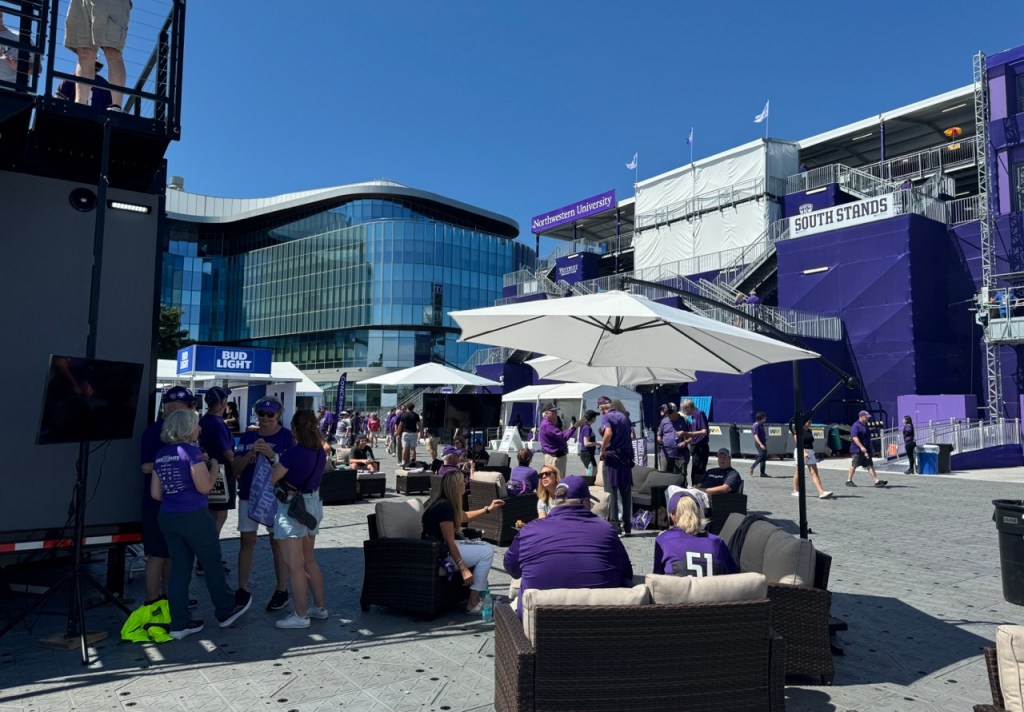
Nearby, three longtime Northwestern football season-ticket holders lounged on patio furniture in a large concessions area inside Martin Stadium, where the team was about to play the Miami Redhawks. The women were enjoying the breeze and watching the game from a big screen. “To have these outdoor seating spots like this,” Cathy Albrecht, a 1982 Northwestern alumna, told Front Office Sports, “We’re like, should we go back in?”
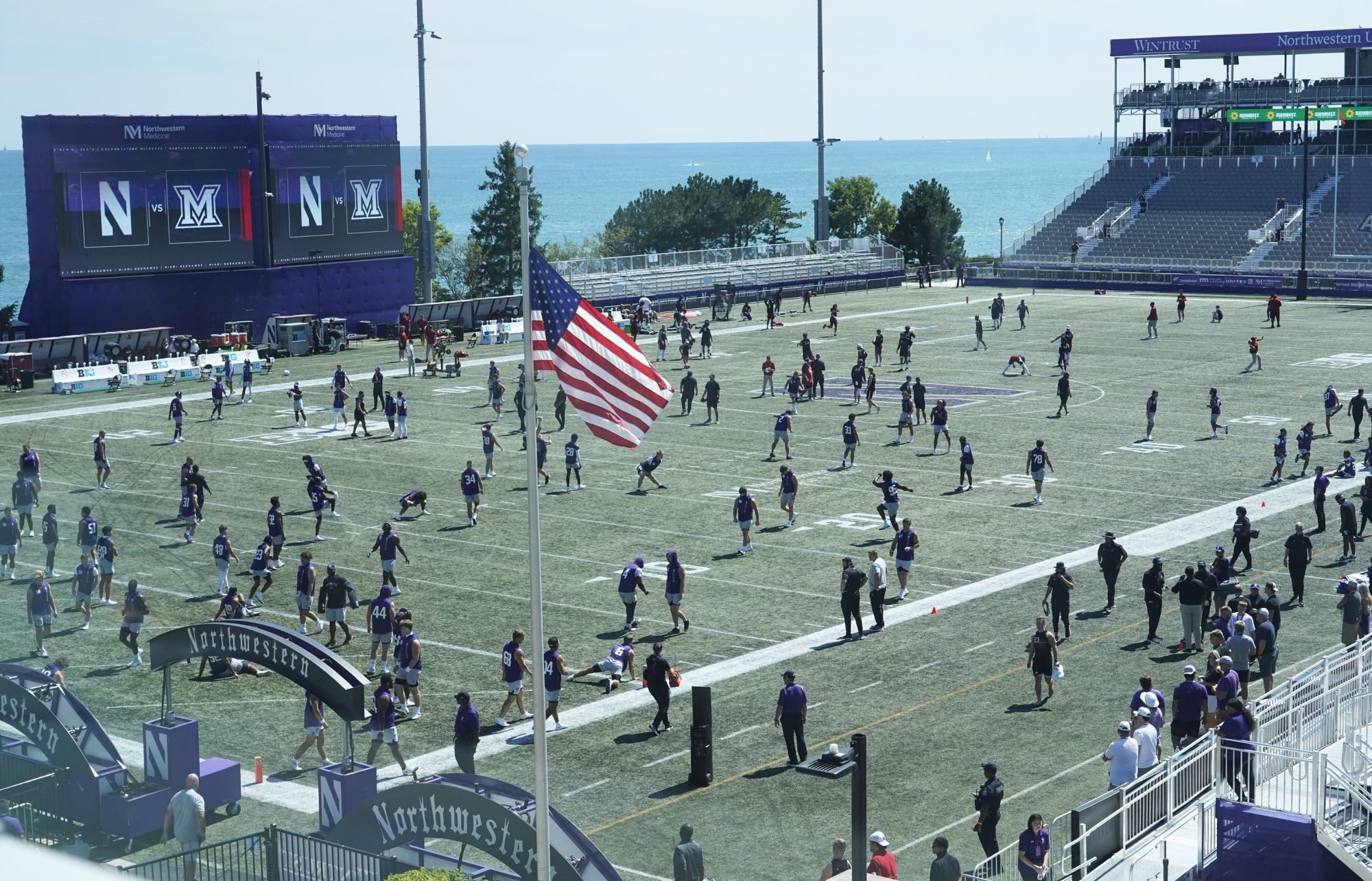
Saturday marked Northwestern’s first game at its temporary, tiny, on-campus stadium, with its sprawling green spaces and tailgating areas along the lakefront. The setup will house the team for two seasons during construction of a new $800 million, 35,000-seat Ryan Field at the off-campus site of the old stadium, which was fully torn down in April. On a sunny, 80-degree day in Evanston, the Wildcats beat Miami (Ohio) before a crowd of 12,023 fans. It would be a paltry crowd anywhere else in the Big Ten, but marked a complete sell-out here.
This fall, Northwestern will play five home games at its lakeside Northwestern Medicine Field, then move to Wrigley Field to accommodate bigger crowds for the Ohio State and Illinois games. It’s a different approach from Kansas, another Power 4 team dealing with stadium construction this season. The Jayhawks will play two non-conference games at Children’s Mercy Park, the home of Major League Soccer’s Sporting Kansas City; and four conference games at Arrowhead Stadium, where the Chiefs play. Arrowhead fits nearly 65,000 more people than Northwestern’s temporary stadium currently does.
Northwestern’s unique approach has—while the weather is still warm, at least—earned rave reviews from players and fans. “Northwestern’s temporary stadium looks so cool I am actively mad they are spending $800 million on a permanent stadium,” sportswriter and alum Rodger Sherman posted. “Northwestern Medicine Field might be the most beautiful stadium in college football,” posted SportsGrid’s Ben Stevens.
“I think that that’s part of the cachet—the intimacy of this,” sports PR veteran Joe Favorito tells FOS. “Kind of like when the Chargers played where the Galaxy play. People wanted to be part of something that was very unique before the massive behemoth comes along, and I think that’s part of the charm of college football that people still like.”
Yet for Northwestern, the victories go beyond a tick in the win column, a full house, and some social media kudos. Northwestern football is making more money in its 12,000–person stadium than it was in previous years with quadruple the capacity, one administrator tells FOS.
The old 47,000–seat Ryan Field, which opened in 1926, only had about 500 premium seats; the temporary lakefront stadium doubled that number. The new stadium opening in 2026 will have even more top-tier offerings. It’s a headline-stealing story that very nearly didn’t happen.
The football stadium is flanked by Lake Michigan to the east and field hockey’s Lakeside Field to the west—“which we would never touch, we have a championship program,” deputy athletic director Jesse Marks tells FOS. Both factors limit seating on the sidelines. To the north is a section of bleachers that fits 5,000 people, including the student section, where tickets are free.
The south end zone is the stadium’s moneymaker. The section begins with 20 clusters of four cushioned chairs positioned around a table, each only a foot or two above the turf. After a block of standard seating are two tiers of club areas that have only a few rows of cushioned seating, but plenty of space to eat and drink from the food and beverage service in the back. On the sides of the clubs are semi-private suites, which are partitioned to simulate a box.
For Northwestern’s next three remaining lakefront games, all-inclusive (non-suite) tickets in these two premium-seating sections—admission, food, and drinks—start at $599 before fees. The prices go up to $699 before fees when Wisconsin comes to town. Season tickets in those sections were $1,299 for the five games. Northwestern is transparent about its “contribution per ticket,” meaning it profits roughly $450 from each season ticket in the premium sections.
“It’s a small community. Everybody knows each other, everybody wants to be around each other when they come back. So, that’s what these premium spaces afford, is the ability for classmates and stuff who want that all-inclusive experience to really do it together,” Marks tells FOS. “And that’s what sold.”
Northwestern is also benefiting from a new revenue stream: in-venue alcohol sales. At the old Ryan Field, fans had to exit the stadium to vendors located outside to buy a beer. Now, stands selling alcohol are plentiful, and so is comfortable patio furniture under large umbrellas in the concessions area. The school might also sell more tickets by adding 3,000 more seats, primarily in the corners and under the scoreboards, Marks says.
Plus, for fans who don’t get a ticket—or don’t want to pay for one—Northwestern constructed a tailgate zone on the lakefront just south of the stadium, with completely separate tickets. For a $25 entrance fee, fans can buy food and drinks, play lawn games, and watch the game on the big screen. Premium areas are also available for purchase, ranging from four camping chairs and a table for ten people ($600) to a two-tiered “Wildcat Chalet” for 50 people that includes two TVs and a refrigerator (starting at $10,000, a football spokesperson tells FOS); none of those sticker prices include entrance to the actual game. The tailgate area was almost totally empty during Saturday’s game, but that’s likely to change as Northwestern students arrive on campus and Big Ten fans come to town.
Big sums in a small space would be a huge win for any university’s athletic department, because football revenues help fund all the other sports. “Where college athletics is going now, the need for non-allocated money is very important,” says Marks, referencing West Coast travel to play new Big Ten opponents.
It wasn’t even a year ago, though, that Northwestern’s football team was receiving the exact opposite type of headlines. Instead of winning praise and printing money, the program was embroiled in both scandal and crisis.
At the forefront were allegations of both coerced sexual acts and a “culture of enabling racism” within the team that led to the firing of longtime coach Pat Fitzgerald. Both former players, alleging systemic abuse, and Fitzgerald, claiming wrongful termination, are suing the school. And opposition from locals over plans to host concerts in the new venue provided a legal threat to rebuilding Ryan Field.
The final approval to break ground on the new stadium in June—alongside a surprising 8–5 season that earned Fitzgerald’s replacement Big Ten coach of the year honors in 2023—has rapidly changed the narrative around the program.
David Braun, named as interim head coach just six months after getting his first FBS job as the school’s defensive coordinator, deserves much of the credit for pulling Northwestern out of the abyss. He took the allegations far more seriously than other former Fitzgerald assistants did as lawsuits flooded in from former players. (As of this July, 40 former players have taken legal action over the alleged hazing.) The wins certainly helped, as did Braun’s enthusiasm for the new temporary stadium. He and his wife Kristin made a “major six figure commitment” to the lakeside plan, which helped get the project off the ground.
The school also hired Sean Dennison, a former communications executive at the MLS and Chicago Fire, to help shape the narrative. Former athletic director Derrick Gragg was kicked upstairs to “vice president for athletic strategy” in June, and Mark Jackson was poached as athletic director from Villanova last week.
“I think it’s certainly impressive in that it could have been so much worse,” says Galen Clavio, a sports marketing expert and professor at Indiana University. “You lose a coach of that reputation and stature and longevity, any one of a number of things can go wrong. … There were a lot of things that kind of went right.”
For all the excitement, Saturday was still the first event in a new facility, and there are plenty of kinks to work out. The downs and yardage were only displayed on a small, hard-to-spot screen in the corner of the end zone; a giant ladder was brought out to adjust a field goal net; and several (very kind) staff members admitted they weren’t sure where seats were located, even after consulting their paper maps.
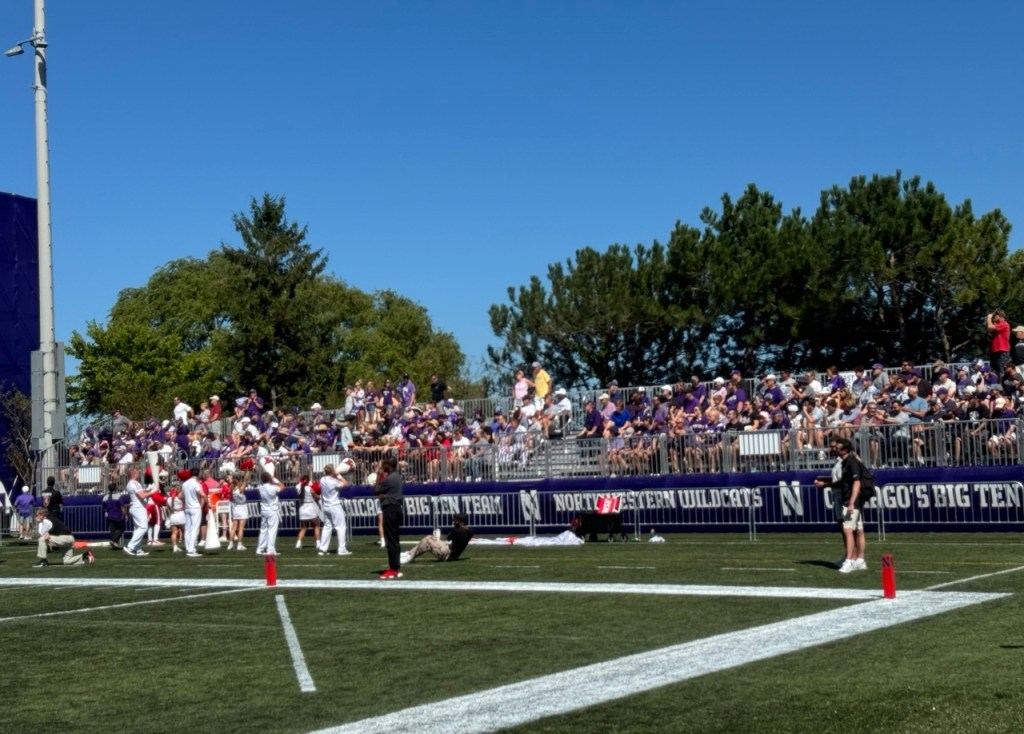
Perhaps most prominently, the opposing cheering squad was positioned not in front of their own fan section in the end zone, but a small five-row section of almost entirely Northwestern fans on the lake-side sideline that included several season ticket holders. As the Miami students used giant megaphones to chant “Defense!”, fans in purple shouted back “Offense!” on the off-beats.
Yet it’s all part of the fleeting experience fans are clamoring for. Clavio says that Northwestern has “taken advantage of a unique situation in a sport that really loves unique situations.”
Marks, for one, thinks Northwestern’s temporary, scenic venue could set a new trend in college athletics. “There’s a reason why a lot of universities haven’t built new stadiums. And that’s because, I guess, the fear and the issues or challenges of, where do we play for two years? What do we do with the revenue?” he says. “We were in a unique situation that many schools couldn’t pull off, but I do think the ability of the temporary stadium or the semi-temporary stadium is something that other schools will now look at in the future as, is this a possibility during a renovation?”
To Victor Matheson, an expert on stadium financing and sports economics professor at Holy Cross, Northwestern’s downsizing is part of an ongoing facilities trend, both in its temporary stadium and permanent new home, which will have 12,000 fewer seats but more premium options than it used to. (Right next door to Ryan Field, Northwestern reduced the capacity of its basketball arena from 8,117 to 7,039 people with a $110 million renovation in 2018.)
“Basically, what we’ve seen throughout sports for the last two or three decades is a move away from gigantic stadiums with lots of bleacher space basically and very simple seats designed to sell the most number of tickets, to smaller facilities that sell fewer but more expensive tickets with a lot more amenities,” Matheson says.
For Monica Weed, one of the Class of 1982 season-ticket holders, the strategy is working. She’s a fan of her new season tickets, located near the 50-yard line with a view of the lake. “We have good seats here,” she said. “We’re going to have trouble going back to the new one.”
Download the FOS App
The business of sports, in your pocket.



Scan the QR code to get the app now.