Want more from Front Office Sports
in your search results?
By: Joe Londergan, @joehio_

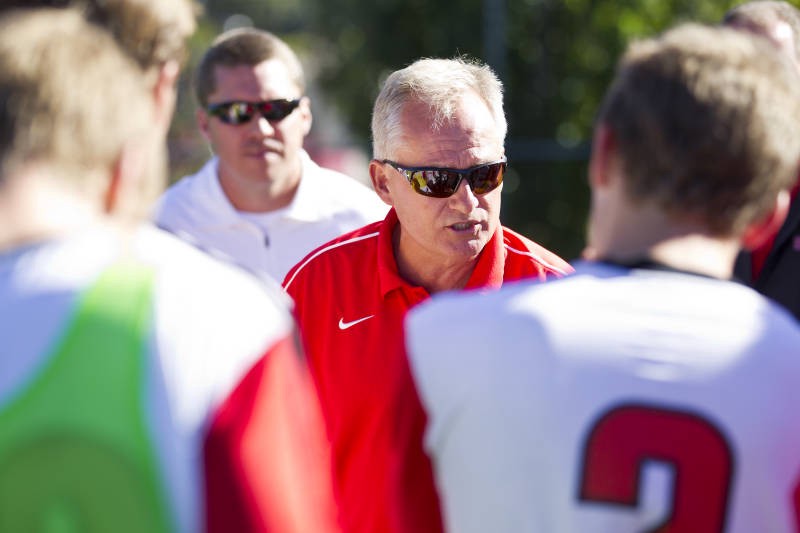
Seattle’s rich soccer scene boasts several names who exemplify the passion and dedication it takes to be truly great. Few are more universally respected than Peter Fewing, Head Coach of Seattle University Men’s Soccer and broadcaster for Seattle’s Major League Soccer franchise, the Seattle Sounders.
Coach Fewing graciously took the time to speak with Front Office Sports on his unique journey to becoming a championship coach. His accolades as a coach include two national championships at the collegiate level (1997 NAIA, 2004 NCAA Div. II) and a national championship in the Premier Developmental League as the head coach of the Kitsap (WA) Pumas in 2011. Most recently, Fewing guided SU to the Sweet 16 of the 2015 NCAA tournament and a national ranking of 12, their best finish since returning to Div. I competition.
Fewing has been exercising his leadership abilities as a coach for nearly four decades.
“I started coaching a youth team when I was in high school. One of our neighbors asked if I would do it. Then I started the camp (Peter Fewing Soccer Camps) when I was 18 years old with another guy, who was 25 at the time, and then he left. He said the camp was mine if I wanted it and I did. It was just kind of a natural fit. I think coaching, teaching, whatever you want to call it, was just part of my DNA.”
Out of high school, Fewing began his career as a collegiate student-athlete at Green River Community College in Auburn, WA, where he played for a season before transferring to the University of Washington. Fewing competed for the Huskies for two years before signing a professional contract with FC Seattle Storm of the Western Soccer league.
“The game was struggling back then, immensely, and we were trying to get it going. We had guys from the USA National Team on our team then. It was fun to play. It was a bummer when those days ended…I was a decent soccer player. I was a journeyman… I worked super hard and I loved it. I snuck into the stadium and trained until one, two or three in the morning. I think that translates into passion for what you’re doing and naturally it goes over to coaching.”
While still playing professionally, Fewing took on the role of the head coach of Seattle University in 1988 and pulled double duty as a professional player and a collegiate coach for three years.
“I didn’t plan on being a college soccer coach. I didn’t really have that vision until Seattle U lost 15–0 to Seattle Pacific University and 8–0 to UW. My buddy, Jeff Koch, was playing for UW at the time and told me they didn’t play any starters against Seattle U. I’m a Catholic guy, it’s a catholic school, I saw what SPU had done winning five national championships and I just thought it should be better over at Seattle U.”
In his first 18 seasons, Coach Fewing led SU to a record of 220 wins, 125 losses and 26 ties with two national championships. After the 2005 season, he made the decision to pursue other opportunities.
“When I left Seattle U, I left because I was told I had to fire all of my assistant coaches and I did not want to do that. I didn’t think that was right. So I wasn’t going to do it.”
It was in this period of transition that the importance of a professional network became clear.
“I used to get dressed up and go have lunch at the Washington Athletic Club so I could continue to bump into people there. Having a network is very important and the way you have a network is to do a good job and treat people right. If you go above and beyond, you’ll get a good network. You have to put your time in and you have to go connect with people. At least an hour of my day is trying to help other people out. That’s an important part of networking is reciprocating: you can’t just go out and think everybody is going to love you and help you out. You have to go out and help them out as well. You don’t do it to get something in return, you do it because you want to support other people, the good part and the reality is that it often comes back to you. Maybe not right away, again, you do it because it’s the right thing to do.”
In 2010, Fewing joined the Kitsap Pumas as the head coach where he remained for two seasons, winning the 2011 PDL championship. During this time, he learned the subtle differences between coaching professional athletes and student-athletes.
“The differences (between coaching college and pro) weren’t as great as I thought. Players still want to work hard. They still want to be committed to something valuable. They still want information, they want to be communicated with. The human element was very similar. You are going to deal with players who need to take care of themselves and continue to do what is in their best interest to grow as professionals. This can be a challenge when you’re building a team on creating brotherhood and unity. You have to get your highest paid players or marquis players to buy in and put the team first. In my work with the Sounders, you have guys who are 17–18 years old and you also have guys who are 35 years old with three kids. So trying to understand where everybody is becomes really important. You can’t pretend everybody is the same. Salary differences can also create obstacles.”
Fewing returned to Seattle University for the 2012 season, the school’s fifth soccer season competing in Division I of NCAA athletics after dropping out of D-I in 1980. Through all of his success on the field, Fewing is sure to have his support staff call him on it if he doesn’t seem committed to continuing the program’s excellence.
“To me, it’s a sin. To not be burning for a national championship as the head coach at Seattle U…The moment I’m not interested in us winning a national championship is the day I have to stop. I once overheard a coach say something along the lines of, ‘Well I only have 17 more years until retirement’. So that’s four groups of student-athletes playing under a coach who’s thinking about retirement every day, and that’s not good. We have to win the national championship. I say that several times a week. We haven’t won a Division 1 title yet, so there’s a lot of motivation in my brain and I know it’s the same in our assistant coaches as well.”
Coach Fewing believes one of his bigger strengths is his ability to connect with his athletes off the field as well as on the field.
“I think I’m a players’ coach. I hope the players know that if they have a problem or an issue, they can come to me and I’ll try to help them. I hope they know that I care about them beyond what they can do on the soccer field. Myself and some of the assistants are actually going to a wedding of a player from our 1998 team. Once you’re in our family, you get to stay in our family.”
However, like many championship winning coaches, Fewing admits that one aspect of this life that he has struggled with at times has been maintaining a balance between work and family life.
“I’ll say this, my oldest is 26, my middle guy is 24, and my daughter is 21. In my young days, I started at Seattle U when I was 24. I was so driven to build the program into a national champion and I spent a lot of time at Seattle U, I spent a lot of time on the road recruiting, I spent a lot of time shaking hands and kissing babies, trying to be at as many events as possible. If I could take some of those situations back, I would, leaving my oldest son at halftime of his soccer game or not going to his game because we had a game at Seattle U. I could have done it better in that regard. Having said that, I’m waiting for a text from my son because we might go out tonight. We’ll have one beer, maybe two and we sit down and we talk once a week and we talk regularly on the phone. It’s really important. Someone once said to me ‘finish this sentence: Balance is…’ and I responded, ‘Balance has nothing to do with excellence.’ If you’re going to be the guy who’s going to get something done, you’re going to be the guy who spends a lot more hours than the guys who are also trying to get something done. So I would say that I wasn’t great at it. I know my children love me, which is really nice. On occasion, I’ve said (to my kids) I’m sorry. But my oldest son is about to come with me to Hawaii for one of my coaching clinics and I have two kids at Seattle U. They know I love them and I know they love me, but I wouldn’t say I was great at the balance part of it.”
With all of the difficulties that come with the job, it can be even more difficult for those with little to no coaching or sport management experience to get their foot in the door. But according to Coach Fewing, this is not an impossible task for those willing to do what it takes.
“My advice is to work your tail off. Be the right kind of guy. Don’t go in and say ‘Well I’m not going to do that job because it doesn’t pay enough or I’m only a head coach.’ For a young person, you really have to go and put your time in. Go and volunteer! Go and watch practices! I’ll also say be willing to sacrifice and also be a really good guy. If you’re a really good guy, people will try to help you.”
Coach Fewing offered these words of parting wisdom for those who hope to establish a career in the sport industry:
“Take care of people. We’re lucky to be in sports. You have a responsibility when you’re in a leadership position to take care of your folks. If you do things the right way, good things will come. If you work hard and treat people right, good things will come. Set high standards and don’t drop below them. It’s not hard to have high standards and hold people to high standards. I’m super lucky to get to do all the things that I get to do between coaching and broadcasting and camps, but I have literally given probably thousands of free speeches.”
“So I put my time in. I started at Seattle U for $12,000 with two jobs and I’ve heard people say that they would never take a job for $12,000. I tell them I wanted the job. I wanted to build something and now my salary is better than that after 22 years, which is good. But you have to be the right kind of guy and you have to treat people the right way. You’ll have more fun if you work hard and you treat people well. There’s no way around it. Looking back, it’s all about the journey and the skills and the processes you pick up along the way.”
Connect with Coach Fewing on LinkedIn here.
Follow Coach Fewing on Twitter here.
Special thanks to Lizetta Solarik and Sarah Tani of Seattle University Athletics for helping to arrange and co-conduct this interview, respectively.
Download the FOS App
The business of sports, in your pocket.



Scan the QR code to get the app now.